Get Full Government Meeting Transcripts, Videos, & Alerts Forever!
Get email alerts on the Rcrc Advocacy topic
No spam. Unsubscribe anytime.
RCRC CEO outlines broadband, forest‑product pivot and mandate work for rural counties
Summary
Pat Blacklock, CEO of the Rural County Representatives of California, briefed the Lassen County Board on RCRC advocacy priorities — broadband funding through Golden State Connect, a pivot by Golden State Natural Resources toward domestic wood‑chip markets and a revised draft EIR, and efforts to document state mandate costs for reimbursements.
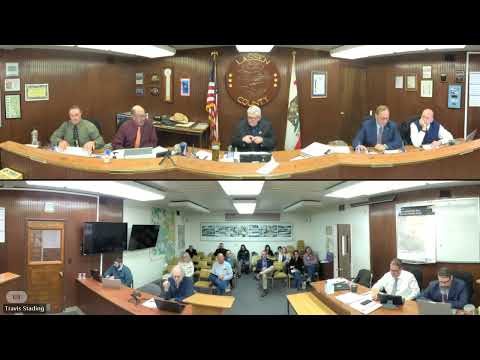
Pat Blacklock, chief executive officer of the Rural County Representatives of California, told the Lassen County Board of Supervisors that RCRC is pressing state and federal officials on broadband, workforce and forest resilience issues and helping small counties pursue reimbursements for state mandates.
"When there's a challenge too big for a small county, they come to us to see if we can get a colony to scale through 40 counties," Blacklock said, describing RCRC's dual mission of advocacy and service provision for rural counties. He said RCRC recently adopted a strategic plan that emphasizes health services, broadband, rural education and resource management.
Blacklock highlighted Golden State Connect Authority, an RCRC affiliate formed to pursue broadband grants and construction. He said the authority has drawn roughly $30 million for engineering work, has secured about $185 million to build publicly owned last‑mile fiber in several counties, and expects to close an additional $100 million bond sale to expand construction funding.
On forest products, Blacklock described a business pivot by Golden State Natural Resources away from international pellet markets toward domestic markets for wood chips and aggregation. He said the company will issue a revised draft environmental impact report in the coming months that focuses on aggregating and shipping wood chips by rail to domestic users and that any commercial deployment is likely several years away.
Blacklock also urged counties to document costs related to state mandates so RCRC can support test claims and pursuit of reimbursements. "By develop a claim, that means we need your documenting costs," he said, noting RCRC has restarted a mandate‑claim effort and contracted outside help to file claims on behalf of small counties.
Why it matters: Blacklock framed the presentation as a practical roadmap for small counties with limited staff and budgets — from seeking construction funding for broadband to finding market pathways that could make forest‑resilience projects economically viable. Several supervisors asked how RCRC's ad hoc committees will translate research into policy and implementation; Blacklock said ad hocs typically work for many months and then bring recommendations to the RCRC board for action.
Next steps: Blacklock said RCRC will circulate materials on the revised draft EIR and may return to Lassen County when project entitlements are sought. He also asked county staff to be prepared to supply cost documentation if RCRC pursues mandate test claims that could generate reimbursements.