Get Full Government Meeting Transcripts, Videos, & Alerts Forever!
Get email alerts on the Public Benefit topic
No spam. Unsubscribe anytime.
Indian River County seeks clearer definition of 'public benefit' for planned developments
Summary
At a joint Planning & Zoning and county commission workshop, staff asked officials whether to codify what counts as a public benefit in planned developments, proposing affordable housing as the top priority and a set of commonly accepted public benefits such as right‑of‑way dedication, conservation set‑asides and off‑site stormwater treatment.
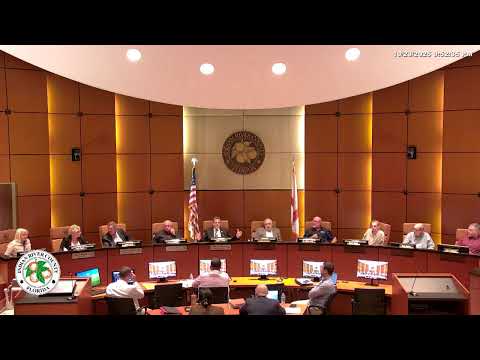
A joint workshop of the Indian River County Planning & Zoning Commission and the Board of County Commissioners on the PD (plan development) process focused first and longest on whether the county should formally define “public benefit” in its Land Development Regulations.
Ryan, a county planning staff presenter, told the group the term currently appears briefly in the code and staff recommends adding an explicit definition and guidance. He listed historically accepted public benefits—including right‑of‑way dedication above the minimum, off‑site stormwater acceptance, off‑site traffic improvements beyond project requirements, extension of sidewalks, conservation set‑asides, dedication of land for public uses, upsizing utility mains and enhanced stormwater treatment to protect the Indian River Lagoon—and said staff wants policy direction from the two bodies.
Why it matters: Commissioners and P&Z members said a clearer definition could reduce surprises and increase consistency across quasi‑judicial PD reviews. Without a transparent standard, applicants and review bodies disagree about what is “over and above” required improvements and what merely benefits a development’s residents.
What was proposed and discussed: Staff recommended affordable and workforce housing be elevated as the county’s top public‑benefit priority. Ryan told the board, “public benefit number one is affordable workforce housing,” and suggested options: making that the primary policy statement, setting a threshold at which providing a set percentage of affordable units satisfies the public‑benefit requirement, and allowing smaller PDs where affordable units are provided. Commissioners also examined whether some benefits should be monetized or tiered and debated whether benefits should be defined countywide or could be neighborhood‑specific.
Legal and technical guardrails: The county attorney and staff repeatedly noted Florida statute limits certain exchanges—for example, impact‑fee credits tied to developer‑provided infrastructure must be treated on a dollar‑for‑dollar basis. Staff also recommended the PD ordinance explicitly state that building height cannot be waived through PDs.
Diverging views: Some commissioners emphasized conservation and off‑site stormwater treatment, citing flood risk and environmental protection around the Indian River Lagoon; others pushed caution about adding requirements that increase lot costs and depress affordability. Developers in public comment warned that extra buffers and prescriptive rules can make lots and houses more expensive, reducing the supply of attainable housing.
What’s next: Staff was directed to draft a definition and guidelines for public benefits and return for more discussion and stakeholder input at a follow‑up meeting planned for January. The workshop produced consensus on seeking staff drafts rather than immediate code amendments and on convening broader stakeholders before finalizing any ordinance language.
Ending: The workshop closed with staff and commissioners agreeing this was the first of multiple meetings; no formal votes were taken.