Get email alerts on the Community Development topic
No spam. Unsubscribe anytime.
Louisa Development Group showcases community-visioning work, seeks continued county support
Summary
Corey Milan and Adair Lentz described a year-long community visioning program that produced professional design plans to strengthen grant competitiveness; presenters asked the board to continue financial support via the 2026 budget and highlighted partners and pilot projects.
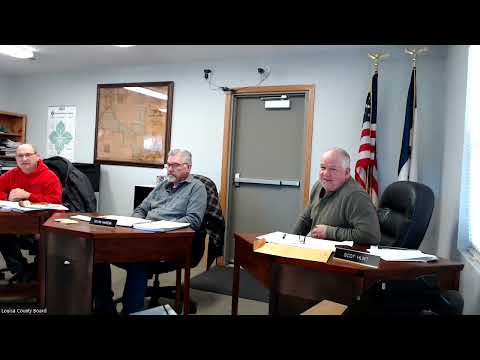
Representatives of the Louisa Development Group (LDG) presented the organization’s community visioning and economic development work and asked supervisors to continue county support as their capital campaign advances.
Corey Milan, who identified herself as the LDG representative, described a year-long Iowa State Community Visioning Program that leveraged a $2,000 local buy-in and an eight-person steering committee to obtain about $150,000 worth of professional design work from a landscape architect. The design package, Milan said, improves communities’ competitiveness for larger infrastructure grants such as those from the Iowa Department of Transportation.
Adair Lentz, the Louisa County Extension director, reviewed recent LDG funding and support. Lentz said the positions and work are sustained through a mix of sources: $12,000 from the Louisa County supervisors, about $10,000 from the cities of Wapello and Columbus Junction, roughly $21,000 raised by the capital campaign in 2025 and 11–12 thousand dollars of support from the Louisa County extension office. The presenters asked supervisors to consider continued support in the 2026 budget.
Why it matters: LDG’s professional designs make communities more competitive for DOT and other grants (presenters cited an 80/20 DOT match example). Milan described pilot projects such as sidewalk connectivity and bump-outs to clarify one-way streets; she said a $1,000,000 estimate with a 15–20% buffer was produced for a main thoroughfare connectivity project.
Board response and next steps: supervisors thanked the presenters and asked staff to keep the board informed. No formal funding vote occurred at the meeting; the presenters asked for support to be considered during the 2026 budget process.
AI generated
The text on this page is AI generated. Summaries, highlights, analysis, and video transcripts are all produced from the original source material.
AI can make mistakes, so if you spot one, and we will fix it for everyone.
Note: the source content is unaltered by us. Any content source we link to, be it a video, an audio recording, or a document, is presented exactly as its publisher released it. That publisher is usually a government body, sometimes an individual official or another organisation.