Get Full Government Meeting Transcripts, Videos, & Alerts Forever!
Get email alerts on the Transportation Mobility Fee topic
No spam. Unsubscribe anytime.
Clay County reviews multimodal mobility fee update after consultants outline $530 million project list and phased increases
Summary
Consultants presented a mobility fee study that models 2045 travel demand and a $530 million project list, proposing district-specific phased fee increases under Florida statute; commissioners pressed consultants on district boundaries, fairness for long-time rural homeowners, and credit rules for developer-built roads.
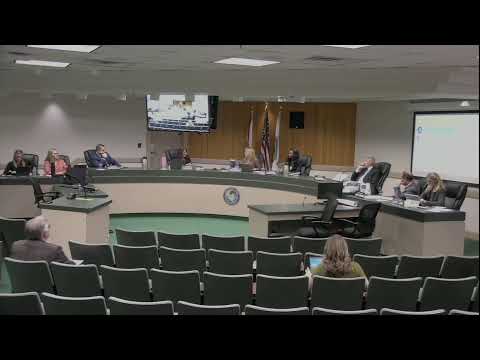
Consultants from GFT and RSG briefed the Clay County Board of County Commissioners on Nov. 25 on an updated multimodal mobility fee study that the county hopes to adopt in January. The study uses a 2024 base year and a 2045 forecast, measures person-miles of travel rather than vehicle miles, and divides the county into five mobility-fee districts to calculate district-specific fees.
"It's a land use regulation that allows you, the local government, to assess a fee on new development to help fund the cost of your public infrastructure," Jeanette Burke of GFT told the board, explaining the dual-rational-nexus approach the consultants used to link fees to projects and to new travel demand.
Consultants said the prioritized project list totals roughly $530,000,000 over the next two decades and that, when divided by the modeled growth in person-miles of travel, the countywide illustrative fee would be about $169 per person-mile traveled if applied uniformly. Because the county adopted mobility districts, fees vary by district and the consultants proposed phasing increases in increments consistent with recent changes in Florida statute.
Commissioners and neighbors focused on who pays. Commissioner Condon argued the district boundaries and fee allocations could impose large costs on owners of generational rural parcels who build single homes. "They're building a house, one house, that is not adding a huge difference to county services, and they have to write a check for $20,000 before they get their building permit," Condon said, citing a constituent who paid about $27,000 in fees.
Consultants and staff told the board the demand and trip-length inputs come from the North Florida TPO model and the county's comprehensive plan, and that districts were retained from the prior study to reflect trip patterns. Jonathan Slayson (RSG) explained that the fee calculation combines national trip rates (ITE), district average trip lengths, conversion factors for person-versus-vehicle miles, double-counting adjustments and regional-road discounts before applying credits for infrastructure built by developers.
The presentation identified credits that developers may earn when they construct eligible mobility projects; credits are generally tied to the district where a project provides benefit unless traffic studies can show cross-district benefit. Consultants said the county will likely supplement fee revenue with existing local sources (local option fuel tax, infrastructure surtax) to close funding gaps where external traffic consumes network capacity.
Board members asked staff and consultants to revisit district boundaries and the project list in places where approved or expected development (for example, Agricola Farms and Clay Dairy Parkway) may affect which parcels bear fees. Staff said they will review maps and provide refinements before a proposed adoption hearing on Jan. 13, 2026.
What’s next: staff and the mobility-fee consultants will return with refined maps, an updated fee schedule and legal-conformance checks; commissioners indicated they want clearer mapping that follows the urban service boundary where appropriate.