Get Full Government Meeting Transcripts, Videos, & Alerts Forever!
Get email alerts on the Capital Budget topic
No spam. Unsubscribe anytime.
Barnstable County unveils FY27 capital plan; two courthouse renovations drive borrowing concerns
Summary
County staff presented a five-year capital-improvement program totaling about $30.5 million and told commissioners two courthouse renovation projects (roughly $3M and $13M) account for more than half the spending; members raised cash-flow, debt-service (10% policy) and reimbursement timing risks and advanced the FY27 ordinance for introduction.
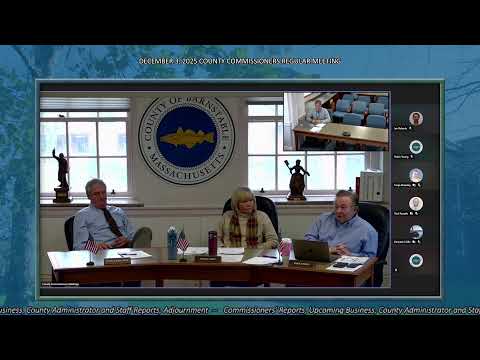
Assistant county administrator Vera Haric and finance director/treasurer Carol Coppola presented Barnstable County’s FY27 capital-improvement program on Dec. 3, outlining a five-year plan (FY27–FY31) that includes 32 projects and totals about $30.5 million.
Haric highlighted that two facilities projects — renovation of the 1st District Courthouse (~$3 million) and the 2nd District Courthouse (~$13 million) — together represent roughly $16.2 million of the five-year total, creating cash-flow and debt-service risks even though the county expects to be largely reimbursed by the courts. Haric warned that reimbursements are subject to annual state appropriation and may be delayed; the county would need to front the projects and borrow to cover interim costs. The board’s financial policy caps debt service at 10% of the operating budget, and commissioners said the courthouse projects could push the county above that limit in FY28–FY31 unless the state or the courts assume some costs.
Commissioners discussed options: engaging state officials and the Division of Capital Asset Management (DCAM) to assume or cost-share the courthouse work; sequestering free cash into a capital stabilization account; and, if necessary, cutting operating expenditures or personnel. Haric said there is an 18-month window (projects slated to start in FY28) to negotiate with courts and state partners before the largest borrowing is required.
Haric also outlined the FY27 slate of seven projects totaling a little over $1 million, including a replacement vehicle for the county dredge program (estimated ~$60,000), design and bid funding for Deeds & Probate HVAC and electrical upgrades (with construction in later years), and remaining funding to complete county administrative office renovations (total project now estimated at $209,000 accounting for escalation). Haric said the capital plan includes projected reimbursements (about $20 million of the five-year plan) but cautioned that reimbursement timing can create interim debt-service pressure.
On a procedural vote, a commissioner moved to introduce the proposed FY27 capital budget ordinance for further consideration; the motion was seconded and approved on a voice vote. Haric said the full ordinance and budget book pages are available to commissioners for review.
Why it matters: the presentation framed a near-term capital program that restores deferred maintenance but creates a potential fiscal squeeze if high-cost courthouse projects are not resolved with state partners. Commissioners asked staff to prepare an aggressive outreach plan to legislators and DCAM as a first priority and to model contingency scenarios.
Next step: the board advanced introduction of the FY27 capital ordinance; staff will pursue discussions with the court system and state officials about reimbursement timing and alternative financing arrangements, and return with further analysis.