Get Full Government Meeting Transcripts, Videos, & Alerts Forever!
Get email alerts on the Water Quality topic
No spam. Unsubscribe anytime.
Barnstable County lab installs state-certified automated water test, cites faster detection and ARPA funding
Summary
County water-quality staff showed commissioners a state-certified automated bacteria detector (Tecta) purchased with ARPA funds, saying it can detect total coliform and E. coli in as little as two hours, speed beach and drinking-water decisions and reduce emergency sample outsourcing.
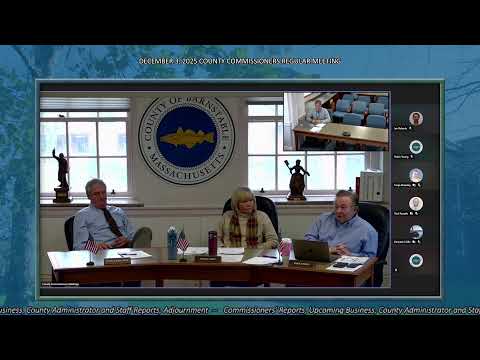
Dan White, director of the Barnstable County Water Quality Laboratory, told the board on Dec. 3 that the lab has received state certification for a new automated bacteria detection instrument (the Tecta), purchased with ARPA funds and — he said — the first certified installation in the state.
White described operational benefits: the instrument runs unattended (overnight or on weekends), reports detections and can send automated email notifications so staff need only check results rather than stay in the lab for readbacks. That capability matters for emergency samples, weekend or holiday testing and beach-closure decisions, White said. "If there is bacteria in the water, it detects it in as soon as 2 hours," one staff member said.
County staff said the technology also has potential for the beach monitoring program, though the state does not yet recognize that method for beach samples; vendor IDEXX has petitioned the EPA to adopt the method federally, after which the county would seek state acceptance for beach use.
Commissioners praised the purchase as a useful expansion of capacity. White said the instrument cost $26,000 (ARPA-funded) and that laboratories generally expect instruments to last about a decade. Staff also discussed parallel sampling projects (a Tetra Tech sampling program of roughly 300 samples for PFAS, VOCs and routine well parameters) and efforts to migrate older data out of an old LIMS so historical tests become more accessible for trend analysis.
Why it matters: faster detection shortens the time between sampling and public-health actions such as notifying water-system operators or opening beaches; keeping such testing in-county reduces dependency on external labs and shortens notification timelines.
Next step: lab staff will publicize the service via a press release and newsletter, continue the Tetra Tech sampling program and monitor EPA/state acceptance if the vendor method wins federal recognition.