Get Full Government Meeting Transcripts, Videos, & Alerts Forever!
Get email alerts on the Referendum topic
No spam. Unsubscribe anytime.
Fond du Lac board reviews $7.5 million referendum draft, security upgrades and possible school closures
Summary
At a Dec. special meeting the Fond du Lac School District Board reviewed a community survey that recommended a $7.5 million, four-year nonrecurring operational referendum, discussed ballot language, a roughly $4 million security package, the possibility of school closures to address declining enrollment, and set deadlines and follow-up meetings ahead of an expected Jan. board vote.
The Fond du Lac School District Board of Education met in a special session to review community survey results and a draft ballot question for a proposed $7.5 million, four‑year nonrecurring operational referendum that staff say would prioritize staff retention, security upgrades and essential educational programming.
Matt Steinbarth, the presenter on the survey analysis, told trustees the polling and comment analysis showed the $7.5 million figure as the “most logical” option, with a weighted support estimate of about 53.8 percent. He said respondents—weighted 75 percent by community members and 25 percent by staff and district parents—ranked transparency in decision‑making, recruiting and retaining high‑quality staff, and school safety and security as the top three priorities.
“Those were the three highest vote getters,” Steinbarth said, adding that the community comments made school closure a notable outlier concern.
Why it matters: Trustees said voters need clearer language about what a yes vote would buy and how funds would be used. Board members and staff debated how specific the ballot question should be: more precise language narrows legally what the district may spend the money on, while broader terms allow flexibility but can reduce voter clarity.
Trustees proposed alternate phrasings to reduce confusion. One trustee suggested replacing “including educational programming” with language such as “maintain quality educational programming,” and another proposed “staff retention and attraction” instead of “staff compensation” to avoid the impression that the referendum exists only to increase pay. District counsel and advisers cautioned that overly specific ballot wording can limit allowable uses and invited trustees to submit written edits for counsel review.
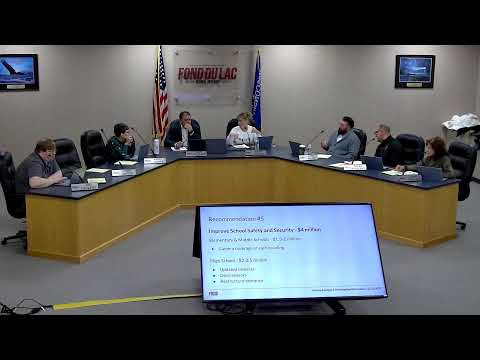
Security and trade‑offs: Staff presented a preliminary security package the district estimates at about $4 million to begin in years one and two if the referendum passes. The presentation broke the work into roughly $1.5 million–$2 million for camera coverage and sensors at elementary and middle schools and about $2 million–$2.5 million for high‑school upgrades, including sensor systems and a restructured secure entrance.
“If we do two entrances [at the high school], we’re looking at $6 million to $6.5 million” for security work at that building alone, a staff presenter said, noting that that scope would require deeper cuts elsewhere in district spending. Trustees emphasized the need for building‑specific cost estimates before authorizing projects to avoid investing in buildings that could be closed under long‑term consolidation plans.
Enrollment and long‑term outlook: Board members raised long‑term fiscal concerns tied to declining enrollment. Trustees and staff cited recent losses of roughly 1,200–1,500 students over the past two decades and warned that even with a $7.5 million referendum passing the district could face operating deficits in later years; staff mentioned a possible $2.5 million deficit in year three under current projections.
Trustees asked the administration to bring forward scenarios showing what could be accomplished within different referendum amounts, what would need to be cut at each level, and which schools, if any, would be candidates for consolidation or closure. Staff said they would provide lists showing projected savings tied to different closure options and cautioned that decisions about closures would require careful planning to avoid imprudent investments in facilities slated for closure.
Timing and process: Trustees were told the board must adopt and file a resolution by Jan. 27, 2026, to place a question on the April ballot. Board members scheduled additional meetings and individual briefings with staff to provide suggested edits and receive refined plans in advance of a vote; the board discussed meeting dates in early January (including Jan. 5 and the regular Jan. 12 meeting) to finalize the question and materials.
Public outreach: Staff outlined a communications plan that would include multiple mailings, listening sessions and targeted outreach—trustees emphasized getting material to seniors, who were highly represented in the survey sample. Trustees asked for a concise one‑page explanation of the ballot question that could accompany outreach so voters clearly understand what a yes vote would fund and what would not be preserved if the referendum fails.
Next steps: District staff will compile trustee edits to ballot language, provide more detailed, building‑level security cost estimates and produce options that lay out what the district would preserve or cut at different referendum levels. Trustees will meet individually with staff before Dec. 22 if possible and reconvene in January to consider a resolution to place the question on the April ballot. The special meeting adjourned after a 7–0 roll call vote at 6:15 p.m.