Get Full Government Meeting Transcripts, Videos, & Alerts Forever!
Get email alerts on the Civilian Oversight topic
No spam. Unsubscribe anytime.
Nashville Community Review Board outlines structure, intake and compliance process to council committee
Summary
The Nashville Community Review Board presented its four-division structure, intake workflow and public-facing data tools to the Public Health & Safety Committee, describing complaint intake options and promising public reports and training programs.
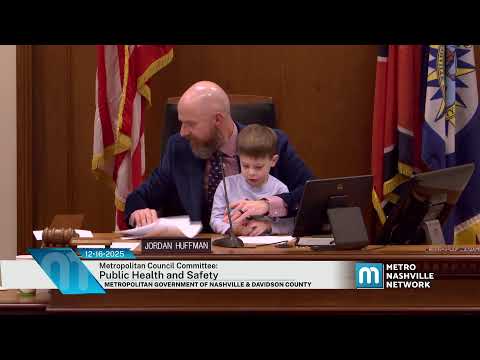
The Nashville Community Review Board (NCRB) presented an overview of its organization and operations to the Metropolitan Council Public Health & Safety Committee on Dec. 14, 2025.
Executive Director Jill Fitchard said the office now operates four divisions—administration, community engagement, research and compliance—and described the agency’s mission as providing an independent avenue for civilians to file complaints related to police conduct and improving trust between residents and the Metropolitan Nashville Police Department. “We provide an independent avenue for citizens or civilians to file complaints related to police misconduct,” Fitchard said.
The administrative division, introduced by Katora Barnett, explained routine fiscal controls: monthly actuals review, a budget invoice tracker and the department’s NCRB budget committee to ensure timely invoices and forecasting for the next fiscal year. Barnett said human-resources priorities include onboarding, professional development and creation of an “NCRB academy” to train new and existing staff.
Damika Cash, community engagement outreach manager, outlined public-facing work including bus wraps, bench ads and billboards, a youth advisory summit and a “Your Voice, Our Mission” series designed to center community perspectives. Cash said the division produces a “public safety community snapshot” tailored to ZIP codes to help residents understand local public-safety conditions.
Senior research analyst Ansley Potter described the unit’s transparency tools: a public open-data portal and recurring reports (a monthly statistical report and an active case progress report) as well as informational and policy-advisory reports. Potter said completed compliance reviews and other public-facing materials are uploaded to the portal following each board meeting and that the department maintains a Civil case-management system to issue tracking numbers to complainants.
Dr. Kim Risby, assistant director overseeing compliance, summarized intake and referral procedures and how the NCRB coordinates with the Office of Professional Accountability (OPA). Risby said complainants can file at the office at 401 Church Street, Suite 1300, by phone via a 24‑hour complaint line or online at ncrb.gov, and that completed compliance review reports are posted online.
The presentation closed after questions from committee members about the status and cost of an ongoing outside investigation; Fitchard said the matter has been on the NCRB agenda for about 19–20 months and that expenses related to the matter exceed $500,000 to date. The committee accepted the presentation and requested the materials be circulated to members.