Get Full Government Meeting Transcripts, Videos, & Alerts Forever!
Get email alerts on the It Portfolio topic
No spam. Unsubscribe anytime.
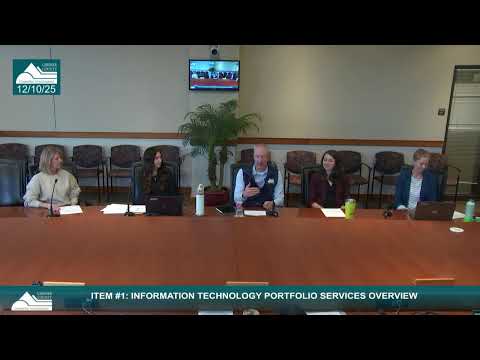
Larimer County commissioners receive IT portfolio and PMO overview; staff highlight governance, intake and recent projects
Summary
At a Dec. 10 work session, Larimer County staff reviewed the county's IT portfolio and Project Management Office, describing an intake funnel, governance by an IT steering committee, recent successes (sheriff JIRA rollout, online appeals portal) and how projects are prioritized and funded.
Larimer County commissioners on Dec. 10 heard a presentation on the county's information-technology portfolio and Project Management Office (PMO), where IT leaders described a structured intake process, governance framework and several recent projects intended to improve service delivery and transparency.
County Support Services Director and Chief Information Officer Mark Pfaffinger told the Board that Larimer County has built "a mature, disciplined portfolio management model" that aligns projects with county goals, prioritizes work through a governance committee and tracks outcomes on a public portfolio dashboard.
The presentation said the PMO acts as a centralized intake and vetting mechanism. Cassie Lullick, the portfolio services director, summarized that the PMO "acts as the county's navigator," documenting requests, scoping needs, estimating effort and routing work to the right execution path — either full projects, team backlogs, or other workstreams. Kelly Haworth, a portfolio services supervisor, outlined the intake funnel: initial meetings, requirement definition, IT complexity assessment and department prioritization. If an idea meets the county's project definition, it is prioritized onto a backlog for the IT Steering Committee (ITSC).
Why it matters: staff said the process reduces failed or unfinished projects by ensuring resource commitment and clear life-cycle planning before projects begin. Over the past five years the presenters reported 125 intakes, with 34 routed into a capital portfolio, 26 moved to ITSC governance review, 8 combined with related ideas, 25 handled as team-backlog work and 32 not advanced into projects. The PMO also said it has delivered dozens of projects and highlighted an earlier count of "over 88 projects" completed under the model.
Staff described how governance works in practice. The ITSC, chaired by Josh Fudge, ranks projects using objective criteria — strategic alignment, consequences of non-action, readiness, probability of success and compatibility with existing IT resources — and produces a prioritized roadmap that informs when vendor work and staffing can start. Pfaffinger said the county funds projects through an ITSC fund and by moving money from capital project funds into operating budgets; there is generally no direct billing to departments except when grant funds apply.
Presenters gave three concrete success stories. Sabrina Santos, who oversees project management, described a sheriff's office rollout of JIRA Service Management that standardized ticketing, increased transparency and improved escalation between IT teams and the Sheriff's Office. Staff also described a Clerk and Recorder initiative that created an online appeals portal for the County Board of Equalization (reported in the presentation as the CBOE project), which allowed more than 40% of appeals to be submitted and scheduled online, reducing manual work and improving evidence retention. Finally, the commissioners' office commissioned a custom Boards and Commissions application to replace a fragmented process; the presenters said it eliminated duplicate data entry and improved reporting and applicant communications.
On measurement, Commissioner Kefalas asked whether the county tracks dollar savings. Staff replied they generally measure "value" and efficiency rather than a single dollar figure, noting that staff time saved is often redirected to other priorities; they said preventing low-probability projects from starting is itself a key metric of savings and stewardship. Pfaffinger said Larimer's approach aims to balance public-safety needs with other county responsibilities and that the ITSC ranking has been tuned to avoid overprioritizing any single category.
Commissioners asked whether Larimer's model is unique. Presenters said few jurisdictions implement as complete an approach, and that Larimer County is often asked to share templates and procedures with peer groups; they also said the county has not commercially marketed the model but frequently participates in government IT associations.
The session closed with commissioners thanking staff for the overview and for "pulling back the curtain" on the behind-the-scenes work. Chair Kristen Stevens adjourned the work session.