
Nash County approves Castellia Spring 50 MW solar farm with added conditions after extended public hearing
Get AI-powered insights, summaries, and transcripts
Subscribe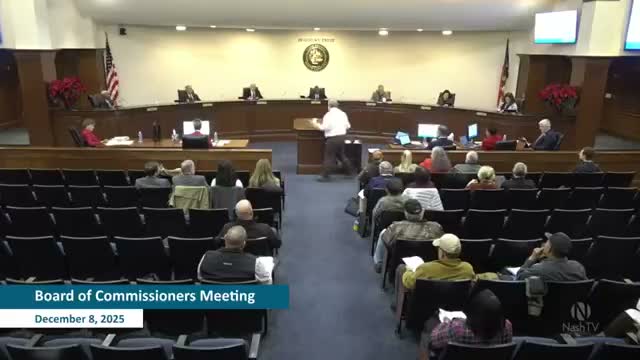
Summary
After a four-hour public hearing, the Nash County Board of Commissioners approved a conditional rezoning for the Castellia Spring solar farm — a 50 MW photovoltaic facility with a 20 MW battery system — adding conditions on construction hours, fence type, screening maintenance and first-responder training.
The Nash County Board of Commissioners voted Dec. 8 to approve a conditional rezoning that clears the way for the Castellia Spring solar farm, a developer-backed proposal for a 50-megawatt photovoltaic array and a 20-megawatt battery energy storage system on roughly 825 acres north of Nashville and west of Red Oak.
Adam Tyson, the county planner, told the board the application would develop about 180 acres within the larger project area and that arrays, inverters and fences would be set a minimum of 100 feet from the project boundary. Tyson said the battery containers and substation would sit more than 1,000 feet from the project edge and more than 2,000 feet from the nearest nonparticipating residence.
The proposal — filed by Castellia Spring LLC, a Hexagon Development subsidiary — drew strong remarks from residents who live near the site and from participating landowners. Speakers opposing the project raised concerns about visual buffers that may decline over time, the appearance of galvanized chain-link fencing, potential impacts on well water and wildlife, noise and traffic during the construction phase, and effects on property values.
“Without a plan, the buffer cannot fulfill its intended purpose,” said Dr. Gretchen Warren, a Taylor Store Road resident who said she visited nearby solar sites and photographed high rates of dead plantings. Warren urged a measurable maintenance schedule and asked who would be responsible for enforcement and repairs.
Developer Ali Kranz of Hexagon Energy responded that the applicant had revised the site plan after public meetings to reduce driveway entrances and to add supplemental vegetative screening where there was no existing vegetation. Kranz also said the project would use crystalline silicon panels that “do not contain any toxic materials or heavy metals” and that the company would comply with UDO landscaping requirements and state decommissioning rules enacted Nov. 1.
Board members debated whether to add site-specific conditions. After discussion the board attached four additional requirements — restricting construction hours to 9 a.m.–5 p.m.; requiring black vinyl-coated chain-link fencing where vegetative screening fronts roadways or adjacent resident properties; mandating an annual screening review in each of the first three years and replacement of dead plantings; and adding the Maumier Fire Department to the first-responder training list — and obtained the applicant’s consent to those terms.
Tyson also reminded the board that the North Carolina General Assembly’s new decommissioning rules require registration with the state environmental agency, a professionally engineered decommissioning plan, financial assurance (bond or escrow), and removal and restoration of equipment within one year of project cessation.
The motion to approve the rezoning and adopt the development conditions carried with one no vote.
What happens next: the project must complete construction permits, Duke Energy interconnection agreements, erosion- and sediment-control approvals, NCDOT driveway permits and local stormwater and electrical permitting before construction. The developer said construction timelines typically run 12–18 months.
Local reaction remained mixed: some neighbors and participating landowners told the board the project preserves family farms and provides revenue alternatives to subdivision or commercial development, while critics urged the county to strengthen enforcement language and long-term maintenance guarantees.
The board’s approval required the developer to submit revised, final materials consistent with the approved site plan and the attached conditions before construction authorization could proceed.