Get Full Government Meeting Transcripts, Videos, & Alerts Forever!
Get email alerts on the Old Jail Assessment topic
No spam. Unsubscribe anytime.
County hears $2M–$3M options to reuse old jail; grant could reduce county share for court work
Summary
Architects presented three conceptual options to convert the old jail/link/courthouse area for court and office use within the existing footprint; estimates ranged roughly from $2 million (retain current path or move inmate entry) to $3 million (new elevator option), and staff flagged a December 31 grant deadline for potential courthouse-improvement funding that could reduce county obligation.
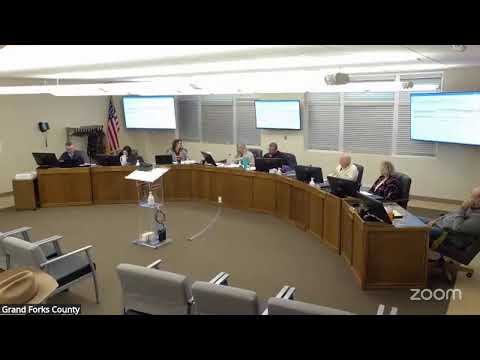
Grand Forks County commissioners heard an architectural assessment of the unused old jail and link to the courthouse and were presented with three conceptual project options and corresponding cost estimates.
Architects Michael Burns and Luke Albertson described Option 1 (retain existing inmate travel path), Option 2 (move inmate entry to a secure North Alley sally port to separate inmate and public circulation), and Option 3 (install a new elevator and reconfigure circulation for ADA access). The study constrained work to reuse within the existing footprint and emphasized feasibility and future-proofing.
Cost and grant context: The consultants presented opinion-of-cost ranges: Project 1 roughly $1.8–2.0 million; Project 2 about $2.01 million; Project 3 about $2.8–3.0 million (the elevator and associated shaft raise costs). The consultants noted a courthouse-improvement grant could offset court-related work (example: a 25% grant match) but that grant funds can only be used for spaces that directly benefit court administration and judicial functions; the victim-advocacy remodel portion would not be grant-eligible and would require full county funding.
Commissioner and staff concerns: Commissioners stressed long-term planning — including the likelihood of an additional judgeship in the next 5–7 years — and cautioned against short-sighted remodels that might later be demolished. Staff and the county court clarified that leasing remodeled space to non-court tenants could disqualify the project from court-grant eligibility. County staff reminded the board that the grant application deadline is Dec. 31; commissioners debated whether to refine plans and apply later or to move forward quickly.
Quotes: "These are not final — the concept here is workable," the study lead said, adding the design team aimed to stay within the existing building footprint. Commissioners noted the small cost difference between moving the inmate path and retaining it — architects estimated minimal variance — and emphasized the value of future-proofing for potential court needs.
Next steps: Commissioners asked staff to consider grant strategy, legislative priorities for larger funding rounds, and to schedule follow-up discussions to firm up scope and timing; staff suggested the commission could submit multiple grant applications but must act quickly if it wants to meet the current Dec. 31 deadline.