Get Full Government Meeting Transcripts, Videos, & Alerts Forever!
Get email alerts on the Renewable Energy Wind topic
No spam. Unsubscribe anytime.
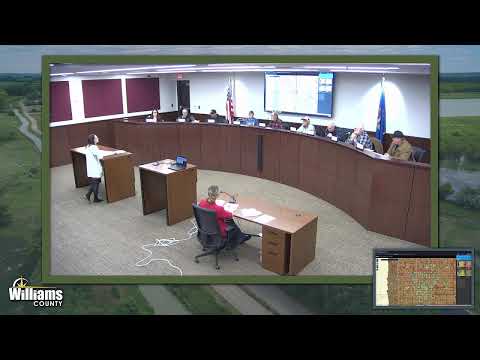
Planning commission approves Homestead Wind CUPs and variances after lengthy public hearing
Summary
The commission approved four land-use applications for the proposed Homestead Wind project — a conditional use permit for the wind facility, a CUP for an ~850-foot transmission interconnect and two variances (fencing/landscaping and participating-owner setback) — after a multi-hour public hearing that drew strong views for and against the project and included applicant commitments on studies, bond and decommissioning requirements.
Williams County’s Planning and Zoning Commission approved four land-use items for the Homestead Wind project, including conditional use permits for the wind energy facility and a short transmission interconnect and two variances from county fencing/landscaping and the 1,400-foot existing-structure setback for participating landowners.
Michelle (planning staff) introduced the package, summarizing the scope: up to 81 turbine locations with no more than 67 turbines constructed, underground 34.5 kV collection lines, an operations-and-maintenance building, project substation, and an approximately 850-foot 115 kV transmission line that will tie into the Strandall substation. Staff recorded township recommendations that ranged from approval to denial, and noted the project footprint spans many townships.
Matt Eberl, senior development manager with Apex Clean Energy, told the commission the project is planned up to 256.5 megawatts and said Apex had secured around 25,000 acres through voluntary agreements. He said the company has completed environmental and geotechnical work, secured a generator interconnection agreement with the Southwest Power Pool, and committed roughly $34 million to local transmission upgrades. "We will then enter our state permitting process in 2026," he said, listing a timeline that sets construction start about 2027 and commercial operations around 2028.
Bree Anderson, Apex’s permitting director, detailed the variances: landowner waivers for fencing/landscaping (to preserve agricultural acreage) and waivers from the 1,400-foot structure setback on participating parcels, while maintaining the 1,400-foot setback from participating residences and at least 500 feet from active oil and gas infrastructure. Environmental staff summarized avian and bat surveys and said no eagle nests were identified within the project area; they said additional conservation planning and coordination with the North Dakota Game and Fish Department would continue.
The public hearing lasted several hours and included dozens of speakers. Opponents warned about noise, visual impacts, potential health concerns, effects on wildlife and tourism, road safety during construction and the process by which townships had been contacted. Supporters — including landowners, a school superintendent and a former utility manager — emphasized long-term lease payments to landowners, tax revenue for schools and local entities, and transmission improvements paid by the developer. The applicant’s team addressed questions about bonding, decommissioning and state oversight. Counsel explained the Public Service Commission requires financial security equal to 5% of construction cost during construction and a decommissioning plan and financial security prior to operations.
After deliberation, commissioners made separate roll-call votes on each item. Each motion passed with multiple yes votes, a small number of no votes on some items and at least one abstention recorded during the sequence. Commissioners noted the items will next go to the Williams County Board of Commissioners for final action on Jan. 6 and will later proceed to the North Dakota Public Service Commission for state-level permitting, decommissioning plan review and financial-security requirements.
The transcript records the commission’s vote to approve all four applications with staff comments and documents that participating landowners provided signed waivers for the setback variances. The decision advances a project that Apex says would generate significant lifetime tax revenue, local lease payments and transmission upgrades, while opponents requested larger setbacks and questioned long-term community impacts.