Get email alerts on the Land Use Subdivision topic
No spam. Unsubscribe anytime.
Seneca County adopts updated subdivision regulations after multi-year review
Summary
The Seneca County Board of Commissioners voted Nov. 13 to adopt updated subdivision regulations, largely clarifying language and aligning the code with current law; the regional planning board will formalize its own resolution following the commission’s approval.
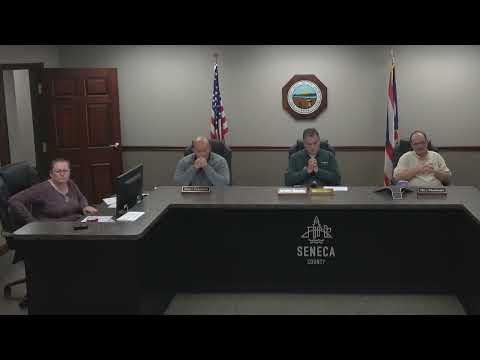
The Seneca County Board of Commissioners voted to adopt updated subdivision regulations during its Nov. 13, 2025 regular session, moving the document forward after a multi-year review by regional planning.
Julie Atkins, regional planning administrator, told the board the review process began in 2019 and that the last comprehensive update to the regulations took place in 2006. “This was one of the goals when the auditor took over as administrator for regional planning — to get these before the board and get them through the process,” Atkins said, characterizing most changes as clarifications and grammatical edits rather than substantive policy shifts. Atkins told commissioners the document had received prosecutor review and that the regional planning board approved the draft on Oct. 1, 2025.
A commissioner moved to accept and approve the regulations “as amended by regional planning”; the motion was seconded and approved by roll call. The commission voted to return the administrative steps to regional planning so that the regional board could adopt a matching resolution. Commissioners said the updated rules aim to streamline lot-split reviews by centralizing coordination with the county engineer, health department, conservation district and tax mapping, reducing the burden on landowners who previously had to visit multiple offices.
The approval at the commissioners’ meeting was procedural: the presenters and several commissioners emphasized the updates are intended to improve clarity and process flow rather than change substantive land-use policy. The regional planning board then moved and seconded a resolution formally adopting the regulations at the joint session that followed; its roll call recorded several yes votes and noted absences among some members.
The next steps are administrative: regional planning will file its adoption consistent with the commissioners’ approval and staff will publish the revised regulations according to county procedure.
AI generated
The text on this page is AI generated. Summaries, highlights, analysis, and video transcripts are all produced from the original source material.
AI can make mistakes, so if you spot one, and we will fix it for everyone.
Note: the source content is unaltered by us. Any content source we link to, be it a video, an audio recording, or a document, is presented exactly as its publisher released it. That publisher is usually a government body, sometimes an individual official or another organisation.