Get Full Government Meeting Transcripts, Videos, & Alerts Forever!
Get email alerts on the Community Connector topic
No spam. Unsubscribe anytime.
Metro outlines community-connector shuttle and mobility-hub opportunities in Clackamas County
Summary
Metro staff described a visionary Community Connector study that identifies shuttle, microtransit and mobility-hub opportunities in Lake Oswego, Happy Valley, McLaughlin/Oakfield and South Wilsonville and previewed a May toolkit and a September report acceptance.
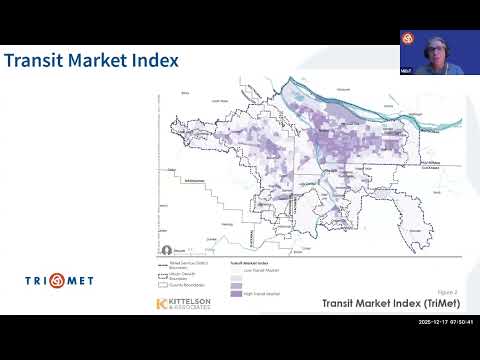
Ali Holmquist, a Metro planner, told Clackamas County officials that the Community Connector transit study is a visionary exercise intended to identify shuttle and microtransit opportunities and potential mobility hubs across the region. Holmquist emphasized the study was not bound by TriMet vehicle-size or immediate operating-budget constraints and that it incorporated iterative local feedback.
Metro used many of the same market factors as TriMet — population density, income and employment — plus local plans and community engagement to identify areas where smaller-scale or on-demand service could close gaps. Holmquist highlighted specific opportunity areas in Clackamas County: in Lake Oswego (Oak Creek/Westlake/Holly Orchard) where connectivity to TriMet lines 37, 38 and 78 may be improved; in Happy Valley (SE Johnson Creek Boulevard area) where on-demand service could bridge a large and topographically complex zone; in McLaughlin/Oakfield where a microtransit connector could tie into lines 29, 32 and 33 and weekday-only service at North Clackamas Park; and in South Wilsonville where prior SMART studies showed limited walk-shed gaps near parks that might be addressed through pedestrian/bicycle links rather than fixed-route service.
Holmquist said Metro will next assess "readiness" for these opportunity areas, develop a mobility-hub toolkit and an implementation guide addressing governance and funding strategies, and return with materials for committee review in May; the study aims to wrap up with a report for acceptance around September. Metro staff noted some areas may be better served by microtransit or car-share than fixed-route shuttles and that future federal funding opportunities could affect implementation timelines.
County and city officials responded positively and urged stronger outreach and coordination with local land-use plans, such as highway-43 visioning in West Linn and proposed youth engagement for the Metro Future Vision Commission. No formal decisions or funding commitments were made during the meeting.