Get Full Government Meeting Transcripts, Videos, & Alerts Forever!
Get email alerts on the Trimet Level Of Service topic
No spam. Unsubscribe anytime.
TriMet study: most Clackamas routes meet market standards; lines 34 and 156 lag on frequency
Summary
TriMet officials told Clackamas County leaders that, using a market-indexed analysis, most routes in the county meet or exceed recommended service standards but line 34 and line 156 fall short on frequency; TriMet and county officials debated trade-offs between coverage and frequency and shuttle solutions for hilly or low-density areas.
Tom Mills, director of Mobility Planning and Policy at TriMet, told Clackamas County officials that a TriMet level-of-service study found most routes serving the county "met or exceeded the market" but identified specific frequency and span gaps on some lines. "We don't have enough revenue to serve all origins and all destinations at all times of the day," Mills said, framing the study as a choice between spreading limited service widely or concentrating it where ridership is highest.
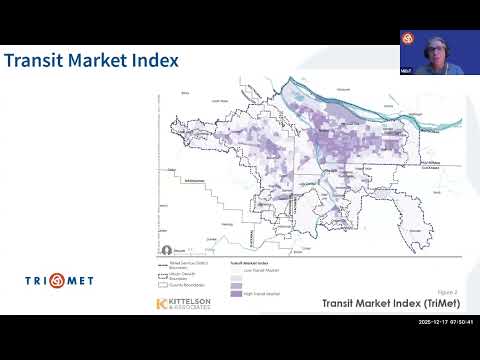
The study combined ten market factors — including population density, median household income and employment density — to score census block groups across the TriMet district. TriMet then assigned frequency and span standards by market quartile: for example, high-market corridors should see service every 15 minutes or better while the lowest markets may be appropriate for 45–60 minute service; span standards range from more than 18 hours per day for high markets to less than 12 for low markets.
Focusing on Clackamas County, Mills said most routes "met or exceeded the market in Clackamas County." He noted exceptions: line 34 (River Road through Clackamas Town Center) and line 156 did not meet the frequency standard, though both have substantial overlap with other routes; line 291 operates only late at night and is not expected to generate heavy ridership during other hours. Mills also said the study team used earlier local work by Kittleson & Associates and guidance from the Transit Capacity and Quality of Service Manual to set benchmarks.
County and city officials pressed TriMet on how the market-based approach treats rural and topographically challenging areas. Commissioner Savas said the region’s funding model is "broken," arguing many Clackamas residents pay for service but lack convenient access. Mills responded that the market index is intended to scale standards for lower-density areas and described TriMet’s regional coordination shuttles and funding support to local shuttle services as ways to extend coverage.
TriMet staff also noted access statistics for the TriMet service district, saying only about 18% of residents in the district live more than a half-mile from a transit stop — a standard the agency uses while acknowledging that topography can make that distance harder to traverse. Councilors and commissioners urged Metro and TriMet to consider local shuttle, on-demand or microtransit solutions for hillier neighborhoods and to coordinate land-use strategies, such as zoning around transit stops, to increase density where appropriate.
The study is informing ongoing discussions about how to balance frequency and coverage across the region; TriMet staff opened the presentation to questions and said they would continue coordination with county staff and local partners. The presentation concluded with TriMet and county staff noting remaining site-specific challenges — particularly topography and low-density corridors — where alternative, smaller-vehicle or on-demand solutions may be needed.