Get Full Government Meeting Transcripts, Videos, & Alerts Forever!
Get email alerts on the Land Use topic
No spam. Unsubscribe anytime.
Laurens County debates stricter open‑space subdivision rules and lot‑size changes; staff to return with modeled scenarios
Summary
Council discussed proposed Ordinance 991 to require 60% open space with a 40% unbuildable‑land threshold, debated buffers and developer incentives, and reviewed proposed amendments to Ordinance 926 (minimum lot sizes). Staff will provide engineering yield examples and revised draft language before second reading.
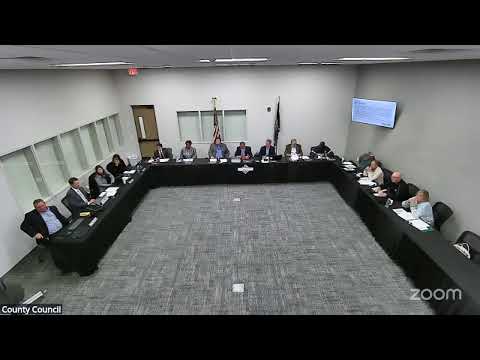
Laurens County Council spent the Nov. 10 agenda hearing reviewing a proposed open‑space (conservation subdivision) ordinance and related lot‑size amendments, debating how to balance environmental protection, aesthetics and developer feasibility.
Wes Mass, the staff presenter, described Ordinance 991 as an update to define open‑space or conservation subdivisions and said the draft would require 60% minimum open space with one of the larger changes adding a requirement that the development site "must consist of a minimum of 40% unbuildable lands," defined in the draft as isolated/connected wetlands, 100‑year floodplain, steep slopes, wooded areas, historic and agricultural sites, and known wildlife habitat (presentation at SEG 620–680). Mass said the requirement was added at the chairman's request to restrict where open‑space developments could be allowed and to preserve the intent of conservation subdivisions.
Councilors exchanged multiple concerns and alternatives. Several members objected that requiring 40% unbuildable land combined with a 60% open‑space minimum would be too restrictive on buildable acreage and could discourage developers; others said the higher percentage would better protect natural resources and raise property values. Recommendations discussed included removing the 40% unbuildable requirement while keeping a strong open‑space minimum, allowing a 100‑foot buffer where the ordinance would otherwise require 50 feet, and offering a density incentive (staff noted a 5% or 10% increase in permitted lots for open‑space plans as an incentive in sample calculations).
Staff walked council through yield‑plan modeling of a 278‑acre example comparing conventional subdivision outcomes with open‑space options (net buildable area, impervious surface caps, and minimum lot sizes). That modeling showed an open‑space approach with incentives could produce materially different lot counts depending on assumptions about minimum lot size, impermeable surface caps and the portion of the site considered unbuildable for environmental reasons.
Separately, council reviewed a proposed amendment to Ordinance 926 to change the minimum lot size for conventional subdivisions using public water and sewer (the draft discussed a 0.34‑acre scenario versus the prior half‑acre standard). Councilors flagged implementation issues if minimum lot sizes change and said staff should provide 'apples‑to‑apples' engineering examples before second reading. Staff recommended separating the obvious, time‑sensitive correction for nonconforming lots (allowing certain lots of record to be rebuilt subject to historical setbacks) and advancing that item sooner rather than bundling it into a larger omnibus revision.
Council directed staff to produce more concrete examples, engineering yield scenarios and draft ordinance language for planning commission review and for council to consider at second reading. No final ordinance adoption occurred at the Nov. 10 meeting.
Quote from staff presenter Wes Mass: "We added a requirement ... that the entire development site parcel or combined parcels in total must consist of a minimum of 40% unbuildable lands." (paraphrased from staff remarks in the presentation.)
Next steps: staff to return with modeled scenarios, clarified definitions (particularly for "agricultural lands" and "unbuildable lands"), draft buffer language and proposed text for second reading and public input.