Get Full Government Meeting Transcripts, Videos, & Alerts Forever!
Get email alerts on the Municipal Finance topic
No spam. Unsubscribe anytime.
Carthage reviews audit, approves plan to bid phased municipal building repairs and readies financing for water projects
Summary
The Town of Carthage received its annual audit showing a roughly $300,000 utility fund gain, heard a plan to bid phase‑1 repairs of the town building, and discussed using a $1 million line of credit plus an internal loan to cash‑flow a $5 million Corps drinking‑water project requiring a $1.25 million local match.
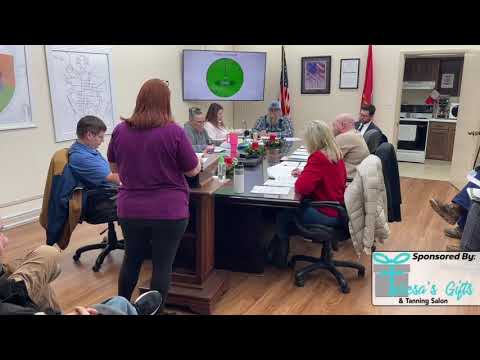
Carthage leaders heard their state‑required annual audit and debated a plan to bid phased repairs to the municipal building while lining up financing for multiple water and sewer projects.
John Poole, CPA, the town’s auditor, told the council the audit for the year ending 06/30/2025 shows the utility system met the state requirement to be profitable. "The utility system had a profit of $300,000 last year," Poole said, and he highlighted interest income and strong cash‑management practices used by finance staff.
Following the audit, an extended presentation from a town official outlined a capital plan tied to several near‑term projects: a $1,000,000 capital construction line of credit with Wilson Bank & Trust (closing is noted as Dec. 10, 2025) to help cash‑flow vertical turbine pumps and a bank‑erosion project; upcoming state revolving fund work on sewer lines; and a previously approved U.S. Army Corps of Engineers drinking‑water project with a total project cost of $5,000,000 and an estimated local cash share of $1,250,000.
The official said the town needs cash flow and recommended a cautious, phased approach to rehabilitating the municipal building: prioritize HVAC and ductwork, electrical upgrades, a dedicated police area and a refurbished recorder’s office, and avoid project expansion in phase 1. "This first phase is dictated by the safety and health of the employees," the presenter said.
Council members discussed financing options. The presenter described two options: a one‑time transfer (allowed in limited circumstances) that would require comptroller approval, or an interfund promissory note from the general fund to the water/sewer fund structured as a loan repayable over about 20–25 years at a rate aligned with the state revolving fund. The presenter recommended using the SRF loan rate for internal loan interest rather than a commercial benchmark.
Council voted to begin the formal bid process for the recommended phase‑1 rehabilitation so contractors can provide firm cost estimates and the council can decide next steps after bids return. The motion to authorize bidding passed with a second; staff were directed to prepare bid specifications and reports for the council.
The presentation repeatedly noted timing risks: multiple projects and draws on cash reserves could coincide in fiscal year 2026–2028, and the town should preserve a $1,000,000 cash buffer in the water/sewer fund where possible. Poole and finance staff were urged to continue incremental rate adjustments and conservative cash management to limit the need for larger emergency increases.
What’s next: staff will prepare bid documents for phase‑1 work and return cost estimates to the council; council members may be asked to consider an interfund loan ordinance or formal transfer if bids and project timetables require immediate cash flow.