Get Full Government Meeting Transcripts, Videos, & Alerts Forever!
Get email alerts on the Child Welfare topic
No spam. Unsubscribe anytime.
CASA reports growth in volunteers and grants; Val Verde County court authorizes partner group to study children's shelter
Summary
CASA told the Val Verde County Commissioners Court it has added volunteers, secured VOCA and HHSC grants and a corporate grant from the James Avery Foundation. The court voted unanimously to form a partner group to explore a county children's shelter and return with recommendations.
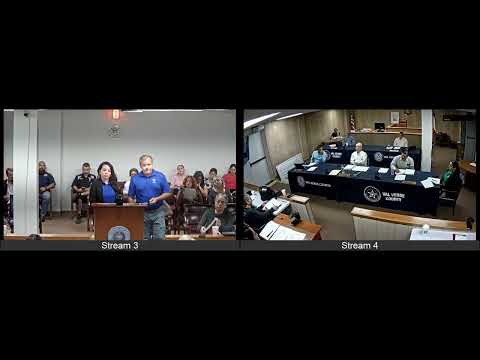
Andrew Pavlinski, newly seated president of the board of CASA, opened a quarterly update to the Val Verde County Commissioners Court on the nonprofit's volunteer and funding progress. "I am Andrew Pavlinski. For those of you that don't know me, I was just seated as the president of the board of CASA," he said, and introduced Carmen to present program details.
Carmen told the court that CASA graduated its first training class July 22 and has continued recruiting: a second class finished in September and a third is mid-training. She said CASA's volunteer advocates provided about 17 hours of advocacy in July, roughly 29 hours in August and 49 hours in September as volunteer capacity expanded. "Without your support, we wouldn't be able to have accomplished what I'm about to share," Carmen said.
On funding, CASA reported its primary public funding comes from a VOCA (Victims of Crime Act) federal grant and that the organization recently won an HHSC grant for the coming fiscal year and its first corporate grant from the James Avery Foundation. Pavlinski and Carmen said the organization is also pursuing additional corporate and local matching funds and maintaining relationships with the city and other partners.
The briefing shifted into a broader discussion of the court's agenda item about a county children's shelter. The judge described local anecdotes of children affected by parental substance use and asked permission to convene partners, including the sheriff, justices of the peace and judges, to explore creating a shelter and a child advocacy center that would co-locate forensic interviews, shelter space and support services. CASA representatives said a regional gap exists and described the child advocacy center model as a "one-stop shop" to bring services to children.
Commissioners and CASA agreed to assemble stakeholders to map needs, review potential sites and funding options and return to the court with recommendations. The court voted unanimously to permit the judge to convene partners and form the study group to explore a children's shelter and related services.
Next steps: stakeholders will be gathered for planning and the court expects a follow-up report. The court did not approve construction or funding at this meeting; it granted permission to organize partners and study the proposal.