Get Full Government Meeting Transcripts, Videos, & Alerts Forever!
Get email alerts on the State Legislation topic
No spam. Unsubscribe anytime.
Delegate Keith Hodges briefs Essex County on General Assembly priorities
Summary
Delegate Keith Hodges updated the Essex County Board on the recent General Assembly session, highlighting the state budget and tax rebates, increased education funding, public‑safety priorities, local‑authority protections, and regional environmental and economic initiatives including blue catfish control and dredging plans.
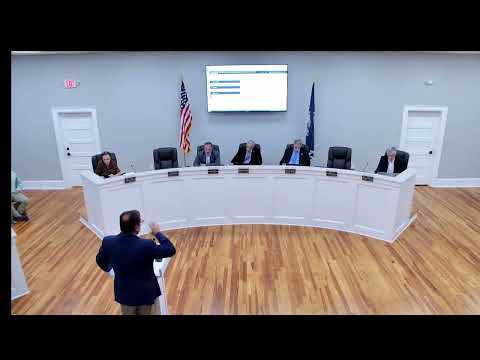
Delegate Keith Hodges spoke to the Essex County Board of Supervisors on Nov. 5 to summarize outcomes from the recent General Assembly session and outline priorities for the coming year.
Hodges said the commonwealth’s budget was large and complex and included both general‑fund and substantial federal passthrough dollars. “We did provide some tax relief for the citizens of the commonwealth,” he said, describing a $200 rebate for individual filers and $400 for joint filers and an increase in the standard deduction (he stated $8,500 for individuals and about $17,000 for joint filers). He characterized budget work on the Appropriations Committee as conservative and bipartisan.
On education, Hodges said the legislature increased per‑pupil funding since the JLARC study and COVID‑era losses, saying local per‑pupil funding has risen substantially (he stated a roughly 53% increase at the local level). He also described a newly enacted limit on certain social‑media access for minors, framing it as a step to address learning loss and youth mental‑health concerns.
Hodges emphasized public safety and law‑enforcement roles: “Public safety is non‑negotiable for me,” he said, thanking sheriffs and deputies for their work. He also repeatedly raised preserving local decision‑making as a priority, saying the board should retain authority over zoning, setbacks and local land‑use choices and that he opposed state bills that would have preempted local control for solar siting or residential setbacks.
On natural‑resource and economic topics Hodges highlighted several regional initiatives. He described an effort to curb invasive blue catfish that prey on juvenile forage fish, saying initial processing/flash‑freezing grant funding grew from $250,000 to $500,000 and that the strategy aims to create processing jobs for watermen and reduce the species’ impact on the Chesapeake Bay’s food web. He also said money from the Virginia Waterway Maintenance program (he referenced $8,000,000 moved into an accessible pot) was being used to support dredging projects that, he said, will improve navigability and property values.
Hodges proposed a Virginia fund to capture part of the market for nature‑based carbon credits (separate from RGGI) tied to oysters and forests. He argued retained proceeds could be used to incentivize private investment, attract firms and return revenue to local landowners and governments.
Board members questioned Hodges about private day‑placement costs for students with IEPs (which reduce a locality’s Average Daily Membership and state funding), the timeliness of budget solutions, and the potential fiscal impacts if a state elimination of the local car tax occurs. Hodges said he would work with supervisors on budget language where appropriate.
Hodges concluded by urging continued local‑state collaboration on dredging, permitting and workforce development, and said he would follow up with staff and supervisors on specific requests.
What’s next: Hodges offered to draft or help craft budget language and to follow up on dredging and fisheries funding; supervisors said they would expect subsequent briefings and written materials for local budget planning.