Get Full Government Meeting Transcripts, Videos, & Alerts Forever!
Get email alerts on the Energy Storage topic
No spam. Unsubscribe anytime.
Dominion Energy briefs Halifax County on battery storage plans and safety measures
Summary
Dominion Energy gave an overview of its battery energy storage roadmap, safety protocols and local economic impacts, answering supervisors’ questions about fire response, siting, technology alternatives and potential tax/revenue shares for localities.
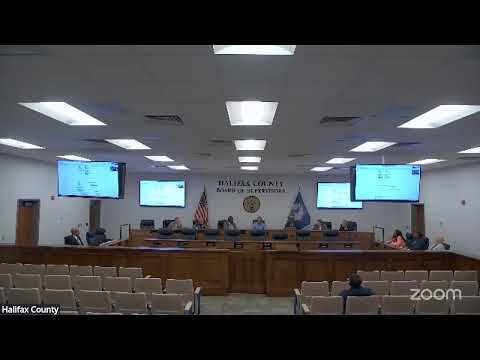
Dominion Energy representatives on Tuesday gave Halifax County’s planning commission and board of supervisors an overview of utility‑scale battery energy storage and answered questions about safety, siting and local economic effects.
"My name is Justin Pope, with Dominion Energy, a local affairs rep," said Justin Pope as he introduced Trey Shuford, a senior generation development analyst, and Ernst Arnold, a safety engineer. Shuford said Dominion’s 2025 integrated resource plan calls for 2,000 megawatts of energy storage and described the company’s current fleet: about 32 MW in operation, roughly 65 MW under construction and about 1,000 MW in development.
Shuford walked the boards through how battery sites are configured, and offered examples of existing and near‑term projects including a 20 MW/4‑hour site in Chesterfield (operational November 2023), a 50 MW/4‑hour project at Dulles (expected this August) and a 15.7 MW/4‑hour site in Sussex County scheduled later this year. "It will produce 20 megawatts for 4 hours," Shuford said, explaining that the 20 MW/4‑hour configuration yields an 80 MWh energy capacity for that project.
Safety and emergency response were the focus of much of the discussion. Shuford described manufacturer testing, UL certification processes (recorded in the presentation), and cited industry standards the presentation recorded as "NFPA 8 55." He said Dominion applies a 25‑foot spatial separation between groups of battery enclosures at its sites, and that battery systems are monitored continuously and equipped with battery‑management and detection systems. "We do design our energy storage facility so that if there is an event, it is contained to 1 enclosure or grouping of enclosures," Shuford said.
On firefighting tactics, the company said response plans are reviewed on a project basis and that, in many thermal‑runaway scenarios, the planned approach is containment rather than applying water directly, which can exacerbate some battery events. Dominion also said it requires training for local fire departments and O&M contractors before equipment arrives on site.
Board members pressed Dominion on alternatives to lithium‑ion chemistries and on community benefits. Shuford said the company is testing non‑lithium technologies (described in the presentation as iron‑air and zinc halide chemistries) that can reduce some safety and supply‑chain risks and, in some cases, provide much longer discharge durations (one example cited was a 5 MW iron‑air system with approximately 100 hours of discharge).
On local revenue, Dominion said jurisdictions can elect revenue‑share in lieu of property tax for storage equipment (the company cited up to $1,400 per installed megawatt per year) and described phased property‑tax exemptions called out in the presentation (80% exemption for equipment the first five years, then 70% for the next five, then 60% thereafter). Dominion also referenced a SolTax tool (developed by UVA and the Virginia Department of Mines, Minerals and Energy) for estimating local revenue under different options.
Supervisors asked whether low‑income or shared‑benefit programs that have been used with solar could apply to storage. Dominion said it would follow up with more information. The presentation closed with an offer to host site tours and to return with follow‑ups on questions raised by the board.
The boards did not take formal action on battery storage at the meeting; the presentation was provided for information while staff and supervisors consider whether to draft local ordinance language.
What’s next: Dominion offered to provide follow‑up details on LMI/shared‑benefit programs and to supply more precise revenue and siting estimates if the county requests them.