
District reports declines in exclusionary discipline and notable CCRPI gains, including subgroup improvements
Get AI-powered insights, summaries, and transcripts
Subscribe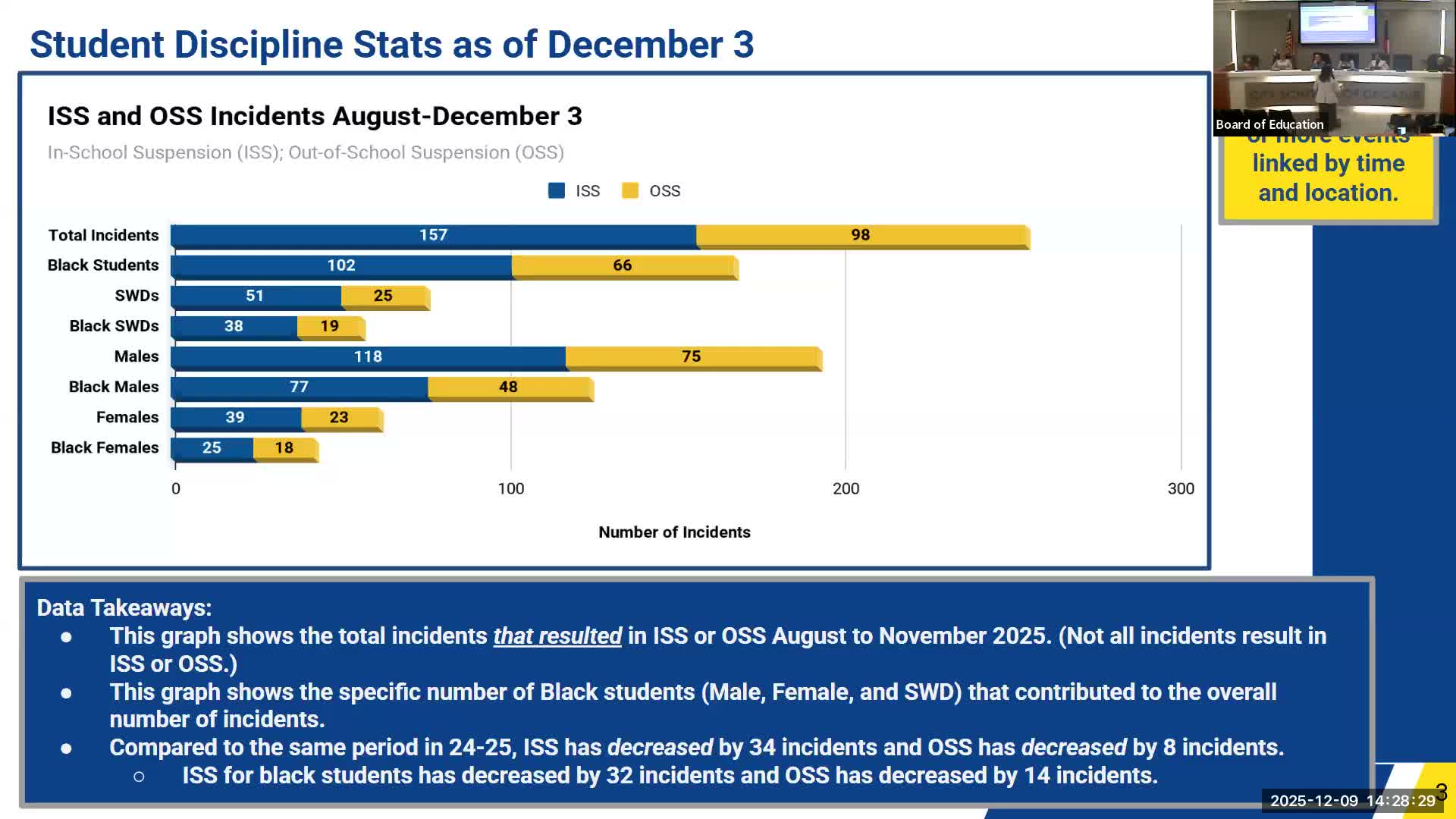
Summary
Assistant superintendent presented discipline reductions and an integrated MTSS/restorative approach; deputy superintendent highlighted substantial CCRPI gains and subgroup improvements, including higher reading readiness and graduation rates for students with disabilities.
City Schools of Decatur officials told trustees that district discipline incidents leading to in‑school and out‑of‑school suspension have declined since last year, and outlined an expanded MTSS and restorative‑practices approach designed to reduce exclusionary discipline and support students at risk.
Assistant Superintendent Frances Hall said ISS incidents fell by 34 and OSS incidents by 8 compared with the prior year (data through Dec. 3). She described district efforts to integrate PBIS and Georgia MTSS with restorative practices, increase real‑time coaching in schools, monitor recidivism, and use BAST‑3 screening (first year for grades 3–12) to guide supports. Hall said intensive supports are being prioritized for students with disabilities, who showed a slight increase in incident counts and require tailored interventions.
Deputy Superintendent Karen Newton Scott presented the 2025 CCRPI story, noting strong content‑mastery and progress metrics in elementary and middle grades and more nuanced but meaningful high‑school results. She highlighted marked subgroup improvements: elementary reading readiness among economically disadvantaged students rose from 43.1% in 2023 to 64.1% in 2025, and graduation rates for students with disabilities rose to 92.16%, surpassing the 90% milestone for the first time in district history.
Trustees asked questions about training for restorative practices, capacity to meet increased psychological‑evaluation demand (psychologist contracting is budgeted), and how access metrics are calculated; staff said forthcoming presentations will break down CCRPI components and subgroup measures in detail. The board commended advances while noting ongoing work to reduce disproportionality and sustain gains.