Get Full Government Meeting Transcripts, Videos, & Alerts Forever!
Get email alerts on the Military Careers And Benefits topic
No spam. Unsubscribe anytime.
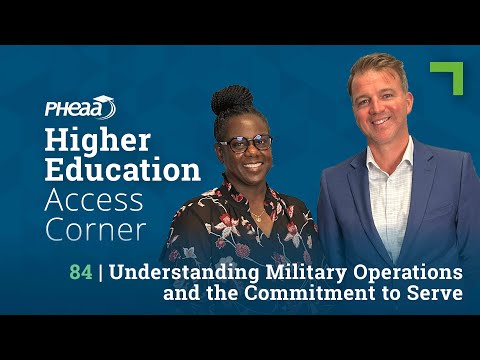
Outreach specialist Dana Neely outlines military pathways, training realities and education benefits for students
Summary
Dana Neely, an education outreach specialist and Navy veteran, advised students and families to "start with the end in mind," prepare for the ASVAB, expect intensive technical training in some fields, and explore Post-9/11 GI Bill and TAP resources for education and transition support.
Dana Neely, an education outreach specialist with the Pennsylvania attorney general's office and a Navy veteran, told listeners of the Higher Education Access Corner podcast that students weighing military service should "start with the end in mind" and research military occupational options and benefits before enlisting.
Neely said maximizing one’s ASVAB score widens job options, and he recommended practice tests, stronger math and science coursework, and conversations with recruiters. "Get any training, any education you can at all time," he said, adding that higher ASVAB scores "are going to give you more options." He also encouraged retesting if an initial score is low.
The podcast highlighted how service can combine rigorous training and paid instruction. Neely described the Navy's nuclear program as academically demanding—long classroom days and heavy study load—and emphasized both the difficulty and the payoff: "You're getting paid the whole time, and you come out of it, and now you have a skill set, education, discipline," he said. He characterizes the military as an investment in people that can translate to civilian careers.
Neely addressed common misconceptions, telling prospective recruits that they are not automatically assigned to combat roles and that assignments depend on branch and job selection. He described the "dream sheet" used to list preferred duty stations and noted historical assignment limits at the time he enlisted: "Women officers first started serving on subs in 2011. And then enlisted women joined in 2016," he said, illustrating how policy and timing affect assignments.
On benefits and transition supports, Neely recommended the Post-9/11 GI Bill (Chapter 33) for returning service members seeking education, saying it typically covers tuition at the highest in-state rate, provides a basic housing allowance tied to school location and offers funds for books (he cited about $500 per semester). He urged families and service members to use the Transition Assistance Program (TAP)—a joint program involving the Department of Veterans Affairs and the Department of Labor—for help with resumes, interview preparation and planning before separating from the military. "They're required to give you that time and space to do it before you hit the ground as a civilian," Neely said of TAP.
Neely also advised logistical preparation—medical and dental records, physical fitness, and honesty about health or other limitations that could affect eligibility—and cautioned families to be patient during the service member’s transition back to civilian life, watching for signs of self-medication and checking in on mental health.
The host pointed listeners toward authoritative resources, including VA.gov and MilitaryOneSource.mil, and mentioned state-level military family education programs overseen by FIA. The episode closed with Neely encouraging prospective recruits to plan carefully and DeVann thanking him for his service and advice.
The podcast episode focused on practical steps students and families can take when considering enlistment, the realities of training and compensation, and the federal programs that support education and transition; it did not report any formal policy changes or vote outcomes.