Get Full Government Meeting Transcripts, Videos, & Alerts Forever!
Get email alerts on the Open Space Ordinance topic
No spam. Unsubscribe anytime.
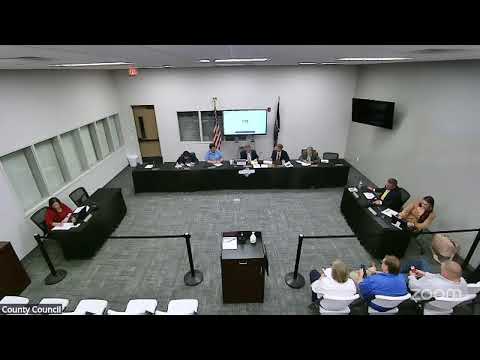
Laurens County committee debates tougher open-space rules as residents and utilities raise infrastructure and affordability concerns
Summary
At a committee-of-the-whole meeting Oct. 13, Laurens County leaders and members of the public dissected proposed changes to the county's open-space development rules (ordinance 991/amendment to ordinance 926), focusing on density, maintenance, setbacks and utility capacity. The planning commission will review the draft Nov. 18 and council expects a second reading in December.
Laurens County council members spent the bulk of a committee meeting Oct. 13 reviewing a proposed rewrite of the county's open-space residential subdivision rules, debating how much land must be left as "open space," whether developers can increase density, and how the county will ensure infrastructure and long-term maintenance.
The committee opened discussion on ordinance 991, which would repeal and replace Division 12 of ordinance 926 governing open-space development. Ethan Anderson, a council member who spoke as a private citizen, framed the debate: "Growth is moving faster than our plan with promises made to the public," Anderson said, urging the council to "set a true definition of open space, demand infrastructure responsibility, and protect your citizens." He argued the moratorium on housing gives the county a chance to require that open space be "clearly defined, enforceable, and permanent," not marketed as private amenities.
Jeff Field, executive director of the Laurens County Water and Sewer Commission, urged a measured approach. "There's not a lot of sewer in the county," Field said, estimating that areas served by public sewer represent "probably roughly 10% of the county," and cautioned that sharp increases in open-space requirements could produce unintended consequences for rates and service. He recommended incremental changes and further technical review.
Representatives of the real-estate community stressed competing priorities. Carolina Abigail Resversett of the Real Estate Association said clustered or open-space development can be "a more efficient use of the space" and can help keep homeownership more affordable if designed properly. Elizabeth Edwards Martin, representing the Credit Greenville Association of Realtors, provided price context: "In 2019, the average price of the house in Laurens County was approximately $59,000. Today in 2025, the average price of the house in Laurens County is $288,000," and warned that added regulations and fees could further raise costs for buyers.
Council members debated several technical elements. They discussed whether to control building massing by limiting structures to two stories rather than by a fixed 25-foot height (concerns were raised that roof pitch could push two-story homes above a 25-foot threshold), how side setbacks should increase with building height (for example, 5 feet for one story, 10 feet for two), and whether to remove minimum lot sizes in favor of setback- and design-based controls. One thread of the exchange centered on whether an open-space plan should be permitted to achieve a higher net lot count than a comparable conventional plan; staff said the current draft does not automatically limit open-space density to conventional density, a change meant to reduce development costs but one that some members said could be exploited.
Members also questioned the proposed open-space percentage. The draft includes proposals moving the county's open-space requirement well above the current 30% (members referenced models and guidance ranging from 40% to 70% in other jurisdictions), and several members recommended testing intermediate values (for example, 45%) to avoid sharply discouraging development in smart-growth areas where infrastructure already exists. The planning staff noted draft language addresses ownership, management and enforcement of open space, including provisions allowing the county to assume maintenance and place a lien on properties if private management fails.
Council and staff also discussed practical site standards: a 50-foot streetscape buffer with 40 feet landscaped along existing road frontages, plot-size thresholds (the draft ties some provisions to a 10-acre minimum for open-space subdivisions), and mechanisms to prevent repeated piecemeal projects that would undermine contiguous natural corridors.
Next steps: the planning commission is scheduled to review the draft on Nov. 18, and staff and council members said they expect to return to the council for more review with a potential second reading in December to allow time to incorporate planning-commission feedback and input from the incoming county administrator.
The committee did not adopt the ordinance at the Oct. 13 meeting; instead, members directed staff to take comments, refine language on enforcement and maintain further discussion before a formal vote.