Get Full Government Meeting Transcripts, Videos, & Alerts Forever!
Get email alerts on the Flood Relief topic
No spam. Unsubscribe anytime.
Central Texas relief funds distribute $3.35 million to flood survivors; applications for round 2 open
Summary
Central Texas Community Foundation and county leaders announced $3,350,000 in short-term relief was distributed to more than 100 households affected by the July 5 floods and said round 2 applications are open at ctxcf.org; officials described vetting, fraud checks and ongoing debris-removal work with state partners.
Central Texas Community Foundation representatives and county judges from Travis and Williamson counties on Monday announced that $3,350,000 in short-term recovery assistance has been distributed to more than 100 households affected by the July 5 floods.
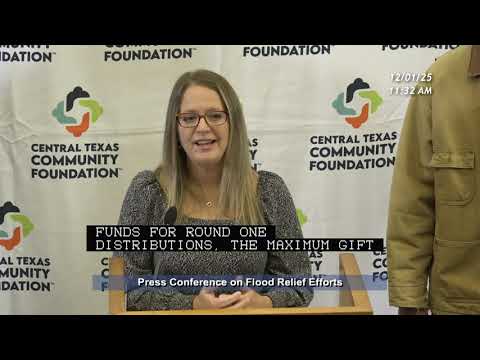
"We began distributing $3,350,000 in short term recovery assistance to more than 100 residents of Travis and Williamson Counties," said Amy, a representative of the Central Texas Community Foundation. She said the funds were delivered as checks or direct ACH payments through Wilco Cares and Travis County Cares.
Judge Andy Brown of Travis County said the combined effort reached 115 residents across both counties in the first round, with about 80 Travis County residents receiving approximately $2,500,000. "These collective efforts mean that 115 residents across our 2 counties began receiving direct financial support last month, totaling $3,350,000 in short term recovery funds," Brown said.
Why it matters: Organizers said the region continues to need aid for major repairs, vehicle replacement and other losses. Brown described many repair estimates ranging from $30,000 to $75,000 for partial-damage homes and said some families face years of rebuilding.
How recipients were chosen: Amy said the foundation and a regional advisory committee used documentation (lease or mortgage, utility bills), income verification and a needs score produced by Texas Mutual Insurance Company’s actuarial team to prioritize awards. "Texas Mutual took our data… and it came up with a needs factor. So every person received a score on that needs factor," she said.
Distribution details and remaining funding: Organizers said round 1 received roughly $8,000,000 in requests. Of that, $3,350,000 was paid in the first distribution and about $5,000,000 remains available for round 2. Amy said the maximum award in round 1 was $100,000, the minimum was $500 and the average award was a little north of $30,000.
Fraud prevention and vetting: Amy said case managers and the vetting process identified about 60 suspected cases of fraud in initial reviews; the foundation reviews eligibility and income while counties focus on verifying physical damage. "We also found 60 cases of fraud," she said, and emphasized the need to verify residency and losses to minimize improper payments.
State and federal recovery work: Judge Brown said Travis County initially used a $15 million reserve and now estimates a little over $21 million ("maybe $22,000,000") has been spent on county response and recovery to date; he said the Texas Division of Emergency Management (TDEM) and the Federal Emergency Management Agency (FEMA) have also expended funds but exact federal or state totals were not provided.
Who can apply and next steps: Organizers said round 2 applications are open at centraltexascommunityfoundation.org (ctxcf.org) under the Flood Relief 2025 tab; the application is available in English and Spanish. Required items include checking the foundation’s impact map to confirm residency within the counties’ flood footprint, photo ID, proof of residency, proof of loss and income verification. Case managers are available to help complete applications, and applicants from round 1 who were not funded will be re-evaluated.
Fundraising plea and timeline: Amy said the relief effort has raised about $8,400,000 so far with a goal of $10,000,000 and urged donations ahead of Giving Tuesday. Officials said long-term recovery committees made up of residents, nonprofits and private partners (including H‑E‑B and United Way) will continue meeting and providing case management for one to three years as rebuilding continues.
What remains unresolved: Officials gave several estimates but did not provide an exact, auditable total for debris-removal costs paid by state or federal partners. Brown said TDEM has taken over much of the debris-removal work going forward but did not provide exact dollar amounts for TDEM or FEMA expenditures.
The fund managers closed by urging residents who incurred personal-property losses to complete applications and by asking the public to consider donating to help unmet needs.