
Travis County lays out near-term spending and delivery plan for $75 million Raising Travis County fund
Get AI-powered insights, summaries, and transcripts
Subscribe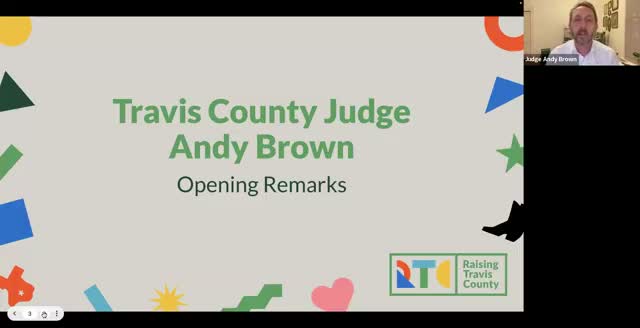
Summary
County officials detailed contracts, scholarship timelines and procurement steps to expand child care and out-of-school-time services: Workforce Solutions will disburse gap payments this month and 1,000 scholarships are expected by January; county staff said $6.5 million in contracts are pending commissioners court approval.
Travis County officials on a virtual town hall described how the voter-approved Raising Travis County fund — a $75,000,000 annual investment — will be used to expand child care access, stabilize providers and grow out-of-school-time programming.
"This $75,000,000 annual fund will expand access to affordable child care for families," Travis County Judge Andy Brown said, framing the initiative as a community commitment to children and families.
Program staff outlined near-term and longer-term steps. Dr. Megan Robinson, senior planner for child care, said staff contracted with Workforce Solutions to expand infant and toddler slots and place 1,000 additional children off the waitlist. Robinson also said county staff signed agreements to provide "gap payments" so providers serving scholarship children are made whole at the county's Travis County child-care quality rate; Workforce Solutions was expected to begin disbursing those payments mid-November and to backdate awards to Sept. 1.
Out-of-school-time lead Roxanne Jimenez said the county counts about 625 out-of-school-time sites but emphasized unmet demand. Jimenez described upcoming procurements and partnerships intended to increase slots and reach underserved areas.
Leah Marnier, the program's strategic adviser, announced additional commissioning and procurement milestones: staff expect to bring new contracts representing about $6,500,000 to the commissioners court for approval, release a request for services (RFS) next month representing roughly $9,000,000 per year for out-of-school-time slots, and issue a spring child-care RFS representing a little over $2,000,000 per year focused on quality and capacity building. She also noted the county had already approved about $21,000,000 in child-care contracts in October and was negotiating an interlocal with the City of Austin that would represent an estimated $3,000,000 per year pending city-council and commissioners-court approvals in January 2026.
Marnier said the program is drafting a long-term implementation plan, hiring a dedicated data-and-evaluation position and contracting a third-party evaluator to measure outcomes and steward taxpayer funds.
Staff described how funds will flow to different program types. Out-of-school-time funding will be administered by the county via reimbursable contracts following an RFS process; child-care scholarships will be administered by Workforce Solutions, which will contact families on its waitlist to offer scholarships and then reimburse child-care centers when children enroll.
On community engagement, Mariana Montejano, the senior planner for community engagement, said the county will deploy a service-location map to track Raising Travis County investments and identify areas with lower service levels; staff expect that map by year-end. The program also launched a website, has new branding approved by the commissioners court, and plans a quarterly newsletter starting in December.
Robinson cited data showing child-care cost pressures: "The median rates in Texas increased by about 11% from 2024 to 2025," she said, and staff said community input ranked expanding slots, nontraditional hours and building provider quality among top priorities.
Staff took audience questions on equity, provider stability and timelines. On provider stability, Marnier said the county has made short-term, two-year investments to support ISD partnerships (she cited a short-term investment for Austin ISD to expand a half-day pre-K3 program to a full day for 216 children and similar short-term support for Del Valle ISD) and said the county is exploring emergency funding for centers and home-based providers facing financial hardship.
Organizers closed by saying the session would be recorded and shared with registrants, and they encouraged community members to submit questions via chat and watch for future town halls and procurement announcements.
Next steps: commissioners court consideration of pending contracts, the RFS release for out-of-school-time slots next month, gap-payment disbursements from Workforce Solutions, and staff hiring and evaluator procurement to begin capturing short- and long-term outcomes.