Get Full Government Meeting Transcripts, Videos, & Alerts Forever!
Get email alerts on the Hotel Tax Policy topic
No spam. Unsubscribe anytime.
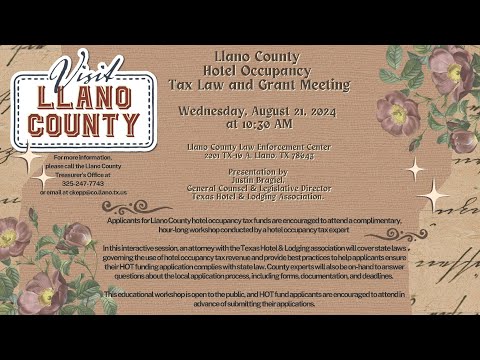
Llano County workshop details legal limits on hotel-occupancy tax spending as grant pool shrinks
Summary
At a pre-commissioners workshop, Texas Hotel and Lodging Association counsel Justin Bragle told Llano County applicants that every hotel-occupancy-tax expenditure must both directly promote tourism and fit a statutory category; he reviewed allowable categories, answered questions about tiny homes and events, and noted the county's grant pool this year is roughly half last year's amount.
Justin Bragle, general counsel for the Texas Hotel and Lodging Association, told a room of grant applicants that county hotel-occupancy tax dollars must meet a strict two-part legal test before they can be awarded.
"Every expenditure must directly promote and enhance tourism and the hotel and convention industry," Bragle said, summarizing the first prong of the test and urging applicants to demonstrate how projects would produce hotel activity.
The second requirement is that the expenditure fit into one of the categories authorized by the tax code. Bragle reviewed the list applicants should use when preparing grant requests: convention centers and visitor-information centers; registration of convention delegates; advertising and promotion; arts-related events and activities; historical restoration and preservation; sporting events that attract tourists and produce substantial hotel activity; and wayfinding or signage.
Bragle used concrete examples to explain the limits. He said a municipal water-treatment plant would not qualify because it does not directly promote tourism. By contrast, a music festival that draws visitors from outside the area and the advertising to attract those visitors would likely meet both parts of the test. "Does it put heads in beds?" he said, repeating the common shorthand for the tourism nexus.
The workshop also covered common questions about what types of lodging are subject to the local hotel-occupancy tax. Bragle said structures rented for less than 30 days—cabins, lake houses and many short-term rentals—are taxable as lodging; structures that are registered as vehicles (for example, tiny homes on wheels) are generally not subject to the county hotel tax and may fall under motor-vehicle-rental rules instead. He noted state and local practice can vary and that counties sometimes adopt more restrictive internal rules than the state does.
Bragle advised applicants to document the tourism impact with reasonable methods: visitor logs, sample surveys, vendor lists, lodging metrics and advertising-impression data. He said the county will evaluate the reasonableness of any methodology rather than expecting exact counts.
During questions, an attendee said porta-potty costs were denied in a prior award round. Bragle explained that hosting costs (security, sanitation, staging) can be paid with hotel-tax funds only when the event itself fits into a qualifying category (for example, a live-music festival fits the "arts" category and therefore related hosting costs may qualify).
Bragle also flagged differences between city and county rules: a city example cited in the session levies a 7% occupancy tax and must spend at least one-seventh (about 14.2%) of its receipts on advertising; cities may also cap arts or historical-restoration spending (the example used a 15% limit), rules that do not apply in the same way to counties.
A meeting participant reported that last year the pool available for hotel-tax grants was $795,000 and that the current amount available for awards is about $423,000. Bragle and his office offered to review applications for legal compliance before the Llano County commissioners consider awards at the Nov. 12 meeting.
The session emphasized that county commissioners have discretion over how local hotel-tax dollars are spent and that applicants who plan to apply to multiple jurisdictions should account for each entity's rules. Bragle closed by encouraging applicants to reach out to his office with questions and to make sure their applications clearly show the tourism nexus and the statutory category that supports the requested expenditure.
The county's application materials and the legal guidance mentioned at the session are available online; applicants were reminded of the Llano County commissioners meeting on Nov. 12, when awards will be considered.