Get Full Government Meeting Transcripts, Videos, & Alerts Forever!
Get email alerts on the Transmission Infrastructure topic
No spam. Unsubscribe anytime.
FirstEnergy briefs Rappahannock supervisors on 13.8‑mile Sperryville line rebuild; residents press for local meeting and SCC engagement
Summary
FirstEnergy officials told the Rappahannock County Board the Page/Sperryville project is a condition‑based replacement of a 138 kV line requiring a State Corporation Commission certificate; residents pressed for a local open house, details on pole heights and easements, and guidance about how to submit comments to the SCC.
Dan Tompkins, director of project engagement and outreach for FirstEnergy, told the Rappahannock County Board of Supervisors on Nov. 3 that the Page/Sperryville transmission project is a 13.8‑mile, condition‑based replacement of an aging 138‑kilovolt line that serves the Sperryville substation. ‘‘This is not a data center project,’’ Tompkins said, adding the company is designing the line to carry 138 kV and must obtain a certificate of public convenience and necessity from the State Corporation Commission before construction could begin.
Why it matters: The line crosses Rappahannock County and national‑park property; residents and multiple supervisors told the company they want more direct local engagement and clearer answers on design and easement impacts. Several speakers asked whether pole heights could nearly double and whether broader rights‑of‑way would be required.
Tompkins outlined the timeline and regulatory steps. He said the company expects to file for the SCC certificate in the first quarter of 2026 and that the SCC process often takes 12–18 months; once filed, the case is assigned to an administrative law judge who sets a procedural schedule that includes public‑comment and intervention windows. He offered a project email (transmissionprojects@firstenergycorp.com), a project website with a virtual open house, and the company’s willingness to accept contact information and connect residents with project staff.
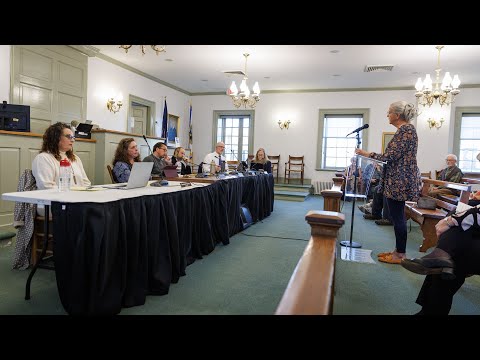
Residents pressed three recurring points: (1) hold a local open house in Rappahannock County (several speakers asked the company to schedule one in Sperryville rather than the project’s November 2024 open house in Luray), (2) disclose pole heights, finish color and conductor arrangements so neighbors can judge viewshed impact, and (3) clarify easement negotiations and whether any property might be condemned. Cary Sutton, a Piedmont District resident, said the towers run on his property and asked FirstEnergy to ‘‘sit down in the community’’ and share final plans. ‘‘I have lots of questions that have yet to be answered because I can’t actually get to them to ask,’’ he said.
Tompkins said the project is largely a like‑for‑like replacement driven by pole condition and engineering safety standards; in some sections monopoles will be taller than the current H‑frame structures but are narrower and can reduce lateral viewshed impact. He acknowledged some easements may explicitly reference wooden poles and said FirstEnergy’s real‑estate staff are working individually with affected landowners to update easement language; he said condemnation is a last resort and not the company’s starting position.
On cost and rate recovery, Tompkins said the utility files its expenditures with regulators and only prudently incurred costs are recoverable; because the project sits in a single PJM pricing zone, costs would be spread among ratepayers in that region. He did not provide a final cost estimate at the meeting but committed to supplying updated reliability statistics and the company’s latest cost estimate to county staff.
What’s next: Tompkins agreed to take the board’s request back to the project team to consider a local open house in Sperryville, and he said he would provide the county administrator the expected SCC filing date once it’s finalized. County staff and supervisors discussed participating as a party in the SCC proceeding and urged wide notification to residents when the filing is made.
Quotes: ‘‘We can’t do the upgrade until we get the certificate of public convenience and necessity from the State Corporation Commission,’’ Tompkins said. ‘‘They’ll take into account public comment . . . all of those components.’’ Resident Cary Sutton asked the board to ‘‘help to ask . . . to hold a community meeting in Rappahannock County.’’
Limits and context: County staff reminded the board that certain state code sections cited at the meeting (local government notice provisions and Chapter 56 provisions for transmission projects) mean a granted SCC certificate can preempt local zoning for the approved line configuration. Staff recommended the county track the SCC docket and consider filing comments or seeking intervener status when the company’s application is filed.
The board and FirstEnergy left the record open for follow‑up: FirstEnergy to provide pole‑height specifics, reliability statistics and a firm filing date; the county to coordinate outreach and consider formal participation in the SCC process.