Get Full Government Meeting Transcripts, Videos, & Alerts Forever!
Get email alerts on the School Budget topic
No spam. Unsubscribe anytime.
Essex County and School Board Agree to Pursue Repayment Plan, Favor Cuts That Avoid Classroom Staff Reductions
Summary
County supervisors and the Essex County School Board reviewed school finance shortfalls tied to prior accounting failures and backed a plan (Option B) that leans on non‑classroom savings and a multiyear repayment—targeting roughly $752,740—while avoiding major classroom layoffs.
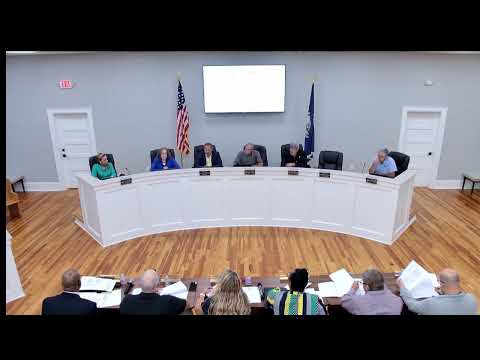
The Essex County Board of Supervisors and the Essex County School Board met in a joint special session to confront unpaid payroll taxes, penalties and other liabilities left from the prior administration and to weigh ways to repay them without unduly harming classroom instruction.
Bobby Tassinari of the centralized financial services team told both boards the district has uncovered missed payroll tax filings and other reconciliations tied to FY24/25 and that the school division already received a roughly $252,000 bill from the IRS for 2024. "We may be facing upwards to about $1,000,000 in penalties this year," Tassinari said, and staff are still reviewing lines of revenue and expenditure to determine final totals.
Dr. Jones, the school division superintendent, presented two options to address the shortfall. Option A would deliver the largest immediate savings but require deep personnel reductions — including special‑education clerks, paraprofessionals, long‑term substitutes, the safety and security coordinator and other positions. Dr. Jones warned that some of those cuts could create compliance and service problems, noting that removing certain counseling or specialized therapy positions "would mean we are out of compliance with what the National School Counselors Association and, by Virginia Code, not having a counselor role in a school," and that cutting occupational therapy would likely trigger compensatory costs later.
Option B, which both boards favored, minimizes classroom and direct‑service job losses. It relies more on operational efficiencies and non‑personnel savings (transportation routing, delayed nonessential replacements, custodial supplies and other line items), targeted salary reductions and temporarily contracting some administrative work. Dr. Jones provided arithmetic for Option B that combined roughly $627,139 in operational efficiencies with about $125,601 in limited personnel‑related reductions to reach a target near $752,740 in recoveries.
County supervisors said they preferred Option B because it reduces the risk of harming instruction. Supervisor (S1) asked the school board to add a budget line item "for interest fees and penalties" so those costs can be tracked month to month. Several supervisors and school board members said they would also forfeit end‑of‑year miscellaneous revenue in future years to accelerate repayment; Tassinari said miscellaneous receipts were last estimated at about $229,500.
School board members and supervisors repeatedly described the problem as a failure of prior oversight. A school board speaker said, "this happened on our watch... we failed in our fiscal oversight role as a collective." County leaders said they will work with the school board on a payment plan and to contest penalties where appropriate.
Both bodies agreed on immediate next steps: the school board will add a budget appropriation line to capture interest, fees and penalties; provide monthly ADM (average daily membership) reports and monthly financial updates so supervisors can appropriate payments as they are incurred; and coordinate a joint town hall to explain capital priorities and the repayment approach to the public. The boards also committed to continuing centralized financial services and to review policies and internal controls to prevent recurrence.
No formal policy changes or personnel terminations were approved at the meeting; the boards discussed options and agreed on a pathway for the school board to adopt specific budget amendments and report back. The joint meeting adjourned after the boards completed the discussion.
Sources and attributions in this report come from the joint meeting transcript and direct statements by Bobby Tassinari (financial services staff), Dr. Jones (superintendent), and multiple supervisors and school board members during the October work session.