Get Full Government Meeting Transcripts, Videos, & Alerts Forever!
Get email alerts on the Land Use topic
No spam. Unsubscribe anytime.
Planning commission votes to recommend 150 MW 'Tobacco Trail' solar project to supervisors with conditions
Summary
After presentations and more than an hour of public comment, the Prince Edward County Planning Commission voted 5–2 to recommend Tobacco Trail Solar LLC’s 150 MW special‑use permit to the Board of Supervisors, while deleting two draft conditions tied to surety reduction and transfer. The board will hold a public hearing before a final decision.
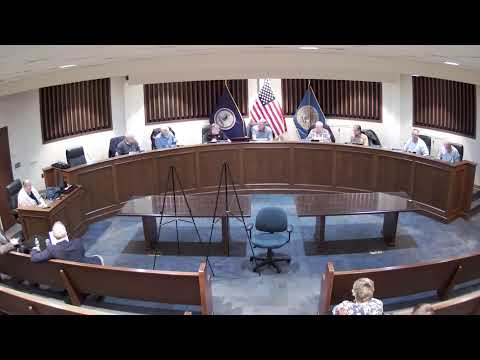
The Prince Edward County Planning Commission on Tuesday recommended that the Board of Supervisors consider a special‑use permit for Tobacco Trail Solar LLC, a proposed 150‑megawatt solar energy facility covering about 2,300 acres, sending the application forward with conditions after a 5–2 roll‑call vote.
The motion to recommend approval, adopted after presentations from county staff, a third‑party reviewer and the applicant, removes proposed language in two draft conditions (identified as conditions 39 and 40) that would have allowed reduction of the required surety when a facility is transferred to another owner. Commissioners voted: Perry — yes; Gilliam — no; Fuller — yes; Copeland — yes; Hart — no; Hogan — yes; Prangaman — yes.
Why it matters: the proposal would site approximately 610 acres of solar panels inside a fenced compound, disturb roughly 500 acres for stormwater controls and preserve about 1,100 acres as tree cover or open space, according to the applicant and staff materials. The developer says the project represents a $306–$317 million capital investment, about $4 million in preconstruction payments to the county and roughly $230,000 in annual revenue sharing. The project, the applicant said, could supply up to 70% of the county’s current electrical demand.
County staff (Mr. Love) summarized the application and noted the required review under Virginia Code 15.2‑2232 comparing the utility facility to the county’s 2045 comprehensive plan. The county paid for a third‑party review by the Berkeley Group; Michael Zayner of Berkeley Group told commissioners the application was complete and compliant with objective regulations, but advised against reducing decommissioning surety to account for scrap or repurposed value.
The applicant, represented by Whitney St. Charles (Development Manager) and Heather McAllister (Permitting Manager) of Strata/StartUp Clean Energy, described mitigation measures including vegetated buffers, wildlife corridors, agrivoltaics on portions of the site, and staged erosion and stormwater controls. "We will be employing screenings and vegetated buffers throughout the site," McAllister said, and the team said they would set back from wetlands and streams and maintain post‑construction pollinator and habitat measures.
During public comment, supporters said the project would deliver jobs and county revenue and cited successful, long‑running solar sites nearby. Opponents raised concerns about loss of agricultural and forested land, habitat fragmentation and hunting impacts, erosion and flooding on local roads, disposal and recycling of panels at end of life, and the financial risk of abandonment. Several speakers asked about batteries; county staff and the applicant clarified the application does not include battery storage.
The applicant addressed technical concerns: an applicant representative explained panel construction — "silicone wafers with silver electrodes ... encased in PVC" — and stated, "There is no lead in these panels," in response to concerns about hazardous materials. On fire safety, Matt Kim (fire protection) said internal 20‑foot access roads and vegetation management would be coordinated with local fire officials to meet Virginia fire‑code requirements.
Commissioners debated whether to table the item for additional local outreach or move it forward. Some urged more district‑level meetings for residents; others noted two prior community meetings and staff’s recommendation. The commission ultimately voted to forward the application to the Board of Supervisors for a public hearing, with the explicit instruction to retain full decommissioning bonding and delete the applicant‑requested language that would allow surety cancellation upon transfer.
What's next: the Board of Supervisors will hold its own public hearing and then decide whether to approve, deny or modify the special‑use permit. The planning commission recommendation and the staff report (including the Berkeley Group analysis) will be part of the materials the board reviews.
Quotes used in this article are drawn directly from the planning commission public hearing transcript and attributed to the speakers listed below.