Get Full Government Meeting Transcripts, Videos, & Alerts Forever!
Get email alerts on the Wind Project topic
No spam. Unsubscribe anytime.
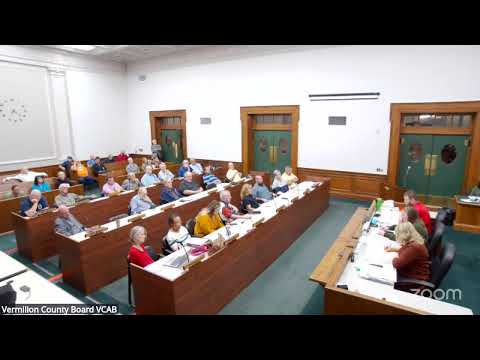
Vermilion County board tables Invenergy wind application after public safety, notice and storage concerns
Summary
After extended public comment about an Invenergy wind project and an added battery‑storage facility, the Vermilion County board voted to table the developer's application while questions about resident notice, battery‑fire risk and decommissioning assurances are clarified.
The Vermilion County board voted to table a proposed Invenergy wind‑energy application after several residents raised concerns about an added battery‑storage component, notice to nearby landowners and emergency‑response readiness.
Developers and supporters told the board the project would produce roughly $100 million in property‑tax revenue over 30 years, provide hundreds of construction jobs and leave a small number of permanent operations jobs. A developer representative described the project as a roughly 300‑megawatt proposal with three turbines removed from the original plan and asked the board for approval.
Residents who live near the proposed site pressed the board on multiple fronts. Frida Wallace, who said her property is less than a mile from planned turbines, told the board she received an incorrect “good neighbor” agreement from the developer and said she had not been notified that an 8‑acre battery‑storage facility had been added. Wallace also alleged that “a county board member contacted me by phone and offered a bribe if I didn’t speak out at the hearing,” charging that the official said he would work to prevent turbines near her property if she stayed quiet.
“I still do not have a printed agreement outlining my property and the compensation I could receive,” Wallace said during public comment, and she urged board members to delay action until residents are properly informed.
Other speakers, including Kevin York and Casey Moore, focused on technical and safety matters. York asked how battery fires would be handled and whether volunteer fire departments in the area would be trained and equipped to respond. Moore cited a provision in the application’s code language that describes battery storage as a “supporting facility” and argued the board should scrutinize how and when the batteries would be charged, whether they could be charged from the grid, and who would be liable for cleanup and compensation if a battery incident occurred.
County staff told the board the developer had agreed to several conditions before a building permit could issue, including a road‑use agreement, a decommissioning plan and an emergency‑response plan worked out with local fire protection districts. Staff also said the developer agreed to post nearly 100% of estimated decommissioning funds up front, whereas the statutory minimum cited in the meeting is 10%.
Board members debated whether the county’s current ordinance and insurance minimums cover the storage portion of the project and asked staff to verify the ordinance language, the required insurance amounts, and whether monetary assistance to fire districts would be provided for specialized training or equipment. Staff said the developer would be required to train and equip local responders as part of the project conditions, but at least one resident said the company had told them directly there would be no additional funding for fire departments.
After public comment and back‑and‑forth questions from board members, a motion to table agenda item 10a (the Invenergy wind application, including the battery‑storage component) was made and seconded. The board recorded a roll‑call result noted in the record as 15 yes, 7 no, 3 absent and 2 abstentions; the chair announced that the motion carried and the item was tabled for further review.
What happens next: The board did not adopt the application; staff and board members asked for follow‑up information about notice to adjacent landowners, specifics of the decommissioning fund calculation, exact insurance requirements, whether any monetary assistance to local fire districts will accompany training and equipment promises, and the practical operations of the battery‑storage system. The item will return to the board when those questions have been resolved or clarified.
Reporting note: The transcript records multiple spellings and variant names for the project and companies involved; this article reports the developer as Invenergy and the county as Vermilion County to match standard local usage and the meeting record.