
Warren City Council votes 5–2 to set 2026 real estate tax rate at 3.4946 mills
Get AI-powered insights, summaries, and transcripts
Subscribe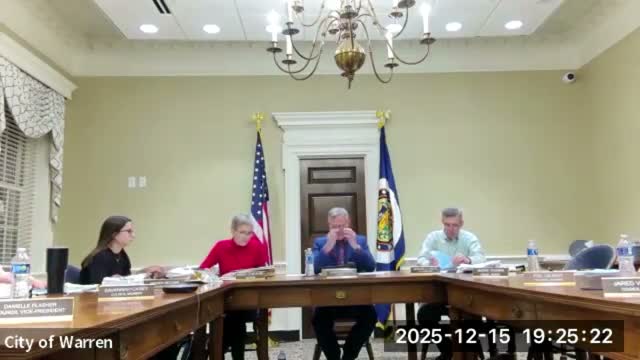
Summary
After extended public comment and council debate about pending county assessment appeals, the Warren City Council voted 5–2 to set the 2026 real estate tax rate at 3.4946 mills, a 5% increase above the calculated revenue‑neutral rate.
Warren City Council voted to set the 2026 real estate tax rate at 3.4946 mills on the dollar after more than two hours of discussion and public comment.
Mayor Wertman framed the debate as one of managing uncertainty from a recent countywide reassessment and thousands of outstanding appeals. "This conversation isn't about the city raising taxes," the mayor said, urging the council that the discussion was intended to maintain revenue neutrality amid uncertain assessed values.
City staff had presented a calculated equalization rate of 3.3282 mills to offset higher assessed values following the county reassessment. State law allows municipalities to adopt a rate up to 10% higher than the prior year's rate; council members debated whether to use that allowance now or wait for appeal outcomes.
Julia Tarr, a downtown business advocate, told council, "I think that raising taxes is not where we need to be at," and urged the body to defer a decision until appeals were resolved.
Council members discussed tradeoffs: leaving the rate at the calculated equalization level could leave the city short if many appeals reduce assessed values, while increasing the rate now could produce a temporary surplus that would need to be reconciled later. Staff presented a range of potential revenue outcomes and noted the difference between the revenue-neutral option and the full 10% increase was roughly $220,000–$240,000 in projected tax revenue.
After public comments and roll call, the motion to set the millage at 3.4946 mills carried by a 5–2 vote. Two council members recorded "no" votes in the roll call. The council will revisit the levy with the 2027 budget cycle if appeals materially change assessed values.
The action followed an earlier, unanimous council vote to acknowledge the equalization calculation (3.3282 mills) as required by state statute.