
Seward County Planning Commission pauses decision on proposed Thresher Wind project after hours of public testimony
Get AI-powered insights, summaries, and transcripts
Subscribe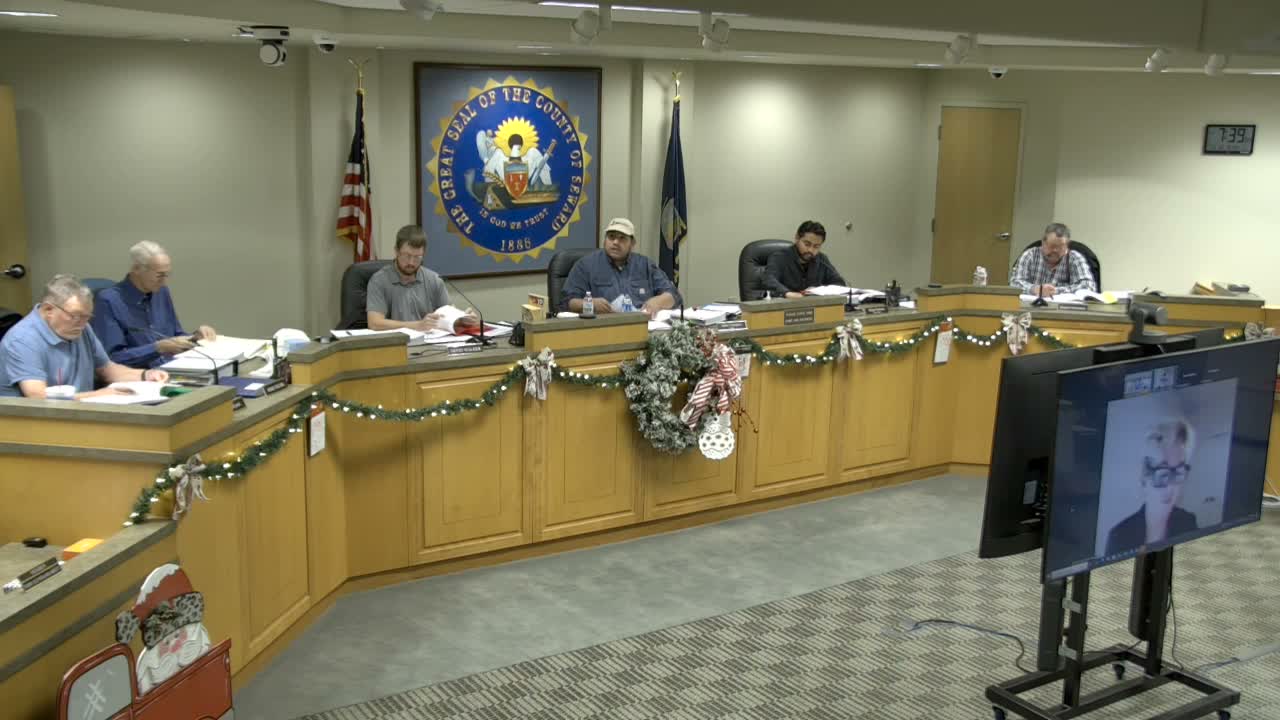
Summary
After a multi-hour public hearing and extensive testimony for and against a conditional-use permit for a commercial wind project in northeast Seward County, the planning commission postponed a decision, set a deadline for written comments and scheduled a special meeting for Dec. 29, 2025.
The Seward County Planning Commission on Dec. 8 opened a public hearing on CU2025-02, a conditional-use permit application by developers identifying themselves as Invenergy and the Thresher Wind Project to place up to 22 wind turbines in the northeast portion of the county. After presentations from staff and the developer and more than an hour of public comment, commissioners recessed deliberations, set a Friday deadline for written submissions and scheduled a special meeting for Dec. 29 to continue consideration.
The Zoning Administrator told the commission the application lists 64 parcels in the northeast county and that the proposal meets the county’s wind‑CUP requirements; staff recommended approval of both the development plan and the conditional‑use permit on the terms in the staff report. Developer representatives Jana Matthews (Invenergy) and Bryce Campbell (Invenergy) described the larger Thresher Wind project as a roughly 1,200-megawatt regional development with about 150 megawatts proposed across Seward County. Matthews said the company anticipates early contributions ‘‘for Seward County, this looks like $465,000 annually’’ to the county and about $243,000 annually to the local school district in the first decade, and that long-term assessed property taxes would begin in year 11.
Developers outlined technical details including a proposed maximum of 22 turbines within Seward County, an assumed 4.5‑MW turbine model with a tip height of about 609 feet and a rotor diameter of roughly 535 feet. Bryce Campbell described mitigation measures the company will use, including underground collection lines, road‑use agreements, a decommissioning agreement and aircraft detection lighting systems (ADLS) intended to limit how often red obstruction lights illuminate at night.
Residents who spoke raised concerns about visual and aesthetic impacts, property values, shadow flicker, noise, and potential effects on farming operations and spraying. Todd Stanton, an adjacent landowner, told commissioners he opposed the project in principle and said public review had been limited: "I think each and every land owner should have the opportunity to capitalize on the economic returns..., but this opportunity must be taken in consideration of the negative impacts on adjoining landowners." Another resident urged a one‑mile setback, saying the current 1,000‑foot standard was inadequate: "I feel that separation needs to be increased to 1 mile." (The developer said its proposed layout in the development plan provides greater setbacks than the county minimum, citing roughly 1,900 feet for participating homes and about 2,400 feet for nonparticipating residences.)
Experts and developer representatives answered questions on transmission, bird and environmental studies, shadow flicker and road impacts. Alan Anderson, identified as an attorney at the Paulson Law Firm and a University of Kansas law professor, told the hearing that Kansas has about 25 years of wind‑project history and that adding low-cost renewable generation typically eases rate pressure for the regional grid.
Following public testimony and staff briefings, commissioners recessed for an attorney‑client executive session under K.S.A. 75‑4319(b)(2) for legal deliberations. After returning, the commission said it would not vote that night; members asked for more time to review written materials and public submissions. The commission established a deadline of Friday at 5 p.m. for written input to be submitted to county staff and set a special meeting for Dec. 29, 2025 at 7 p.m. to continue the hearing.
Actions recorded during the meeting include unanimous votes to approve the agenda, minutes and meeting schedule earlier in the evening; adoption of hearing guidelines for this public hearing; motions to enter executive sessions; the setting of the written‑comment deadline and the Dec. 29 special meeting; and the meeting’s adjournment.
The application packet and staff report (including proposed conditions) remain part of the public record; the commission will consider the full record, written submissions filed by the Friday deadline and any additional materials at the Dec. 29 special meeting.