
Charter committee recommends informational guidance to Board: protect rural character and encourage developers to meet state housing requirements
Get AI-powered insights, summaries, and transcripts
Subscribe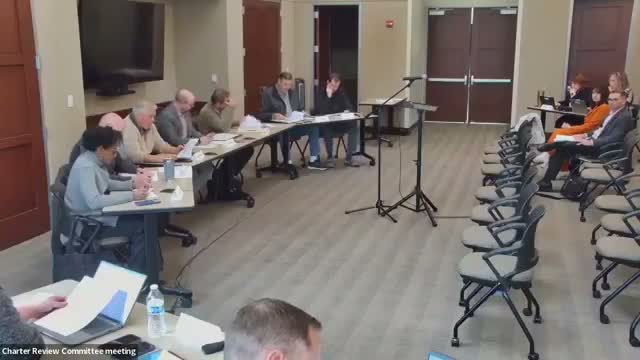
Summary
After legal advisories that the charter cannot override state RHNA and rezoning law, the committee voted to forward an informational recommendation asking the Board to incorporate a concept into the general plan: protect rural/low‑density zones from inappropriate high‑density encroachment and enact policies that encourage developers to build the affordable housing required by state law.
The Charter Review Committee spent substantial time Dec. 8 on how to address regional housing needs assessment (RHNA) numbers and where multifamily housing can be located without unduly encroaching on rural communities.
Ben Mills opened the staff presentation on RHNA, zoning authority and state preemption, noting that land‑use, RHNA and zoning are considered areas of statewide concern and ‘‘continue and counties cannot override those state mandates through a charter.’’
Committee members repeatedly pushed for a way to protect rural communities from concentrated rezoning that residents said could overwhelm small towns. Public commenters from Penryn and other rural communities described the Hopeway (Hope Way/Hopewy) project and said a 240‑unit proposal could double Penryn’s population and overwhelm infrastructure. Muriel Davis urged the committee to recommend that rezonings in rural areas require full environmental review rather than a programmatic approach; ‘‘When they rezone an area in the rural areas...I would like to see the charter recommend that they do a regular EIR to evaluate the safety and the health and the hazards that would be created,’’ she said.
Legal counsel (identified in the transcript as Clayton) explained limitations: mandatory charter language limiting rezoning or excluding affordable housing from certain areas would likely be preempted by state law, and could be voided or subject to legal challenge. ‘‘Whenever the legislature has seen fit to adopt a general scheme for the regulation of a particular subject, the entire control over whatever phases of the subject are covered by state legislation ceases as far as local legislation is concerned,’’ Clayton said.
Faced with that legal constraint, the committee agreed to transmit the substance of the public concern to the Board as an informational recommendation to be included in the county's general plan process rather than as a binding charter amendment. The final language the committee approved (as an informational recommendation) asks the Board to incorporate the following concept into the general plan process: protect rural and low‑density zones from encroachment of high‑density development inconsistent with local character or neighboring zoning, and enact policies that encourage developers to build affordable housing sufficient to meet state requirements.
What happens next: The committee will include the approved wording in its transmittal to the Board of Supervisors and request that the Board consider incorporating the concept into the general plan process and related policy work (including the pending nexus study staff expects to brief in early 2026).