
Tennessee Department of Revenue tells businesses to keep “three years plus current,” verify exemption certificates and use online portal for refunds
Get AI-powered insights, summaries, and transcripts
Subscribe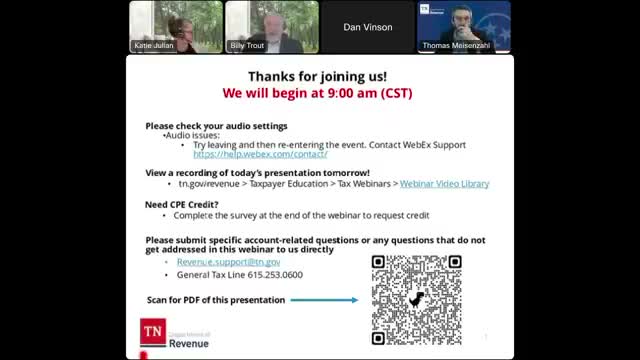
Summary
Department presenters advised businesses and tax professionals to retain supporting records (three years plus the current year), retain exemption certificates (and verify them), and use the department’s online account tools for refund claims and notices; interest on assessments was described as non‑waivable under state statute.
The Tennessee Department of Revenue on its year‑end webinar walked businesses and tax professionals through recordkeeping, exemption certificates, statutes of limitation and dispute options, stressing that good documentation speeds audits and refund processing.
Billy Trout, manager of taxpayer education for the Tennessee Department of Revenue, opened the webinar and introduced Katie Julian (presenter) and Thomas Meisenzahl, a tax auditor supervisor in the department’s audit division. "Accurate record keeping is not just good business practice, but it's essential for tax compliance and can make a big difference when you're preparing for an audit," Julian said.
Meisenzahl said the basic retention rule for state tax matters is "three years plus the current" year measured from when a return was filed. He added that federal retention rules can differ and often require longer retention for matters that affect basis, depreciation or federal credits. He recommended keeping police reports and insurance documentation when theft or disaster affects inventory so taxpayers can substantiate losses during an audit.
On exemption certificates, Julian said retailers must retain a certificate that supports any claimed exemption (resale, agricultural, nonprofit, government). She advised checking expiration dates for some certificate types and using the department’s online verification tool if a certificate looks suspicious. Meisenzahl cautioned that certain manufacturer or industrial exemption certificates are renewed annually and that payment methods (checks or cards) must match the exempt entity’s name to be protected under the department’s good‑faith provisions.
The panel described the department’s rule on assessments and refunds: the department generally may assess taxes within three years from Dec. 31 of the year the return was filed; there is no time limit when no return was filed or when fraud is involved. For refunds, the department tries to process claims quickly (the webinar noted a typical internal target of about 45 business days), but staff must review supporting records before a refund is approved. Billy Trout walked viewers through filing a claim for refund through the department’s online account interface, advising taxpayers to attach supporting documents to speed processing.
On dispute resolution, Katie Julian explained that a taxpayer receiving a Notice of Proposed Assessment (NOPA) may request an informal conference in writing within 30 days; the department generally contacts the taxpayer within 10 days to set a time. Meisenzahl said these conferences are conducted by hearing officers who are attorneys separate from the audit staff and serve as an independent review; taxpayers retain the right to take matters to chancery court instead of using the informal conference.
Meisenzahl emphasized that interest on assessments continues to accrue while disputes are pending and cited the webinar’s reference to TCA 67‑1‑803, noting the statute limits waiver of interest. "Interest keeps accruing until it's all paid," he said.
During a broad Q&A, the panel answered delivery and access questions (NOPAs are sent to taxpayers' online accounts and may be mailed according to a taxpayer's preferences), discussed the department’s ability to handle electronic records (taxpayers who keep electronic records must provide them in standard electronic format upon request), and advised that the department receives 1099‑K/credit card reporting and other federal information that can be used in compliance work. The panel also encouraged small or new businesses to attend the department’s quarterly new‑business workshops and described how to request CPE credit for webinar attendance.
The department closed by pointing attendees to the webinar video library on tn.gov/revenue (Taxpayer Education and Outreach → Tax Webinars) and providing contact information for follow‑up: revenue.support@tn.gov and (615) 253-0600. The recording and slide PDF will be posted to the webinar library.