
Kerr County workshop flags BESS safety, urges permit fees and expert review
Get AI-powered insights, summaries, and transcripts
Subscribe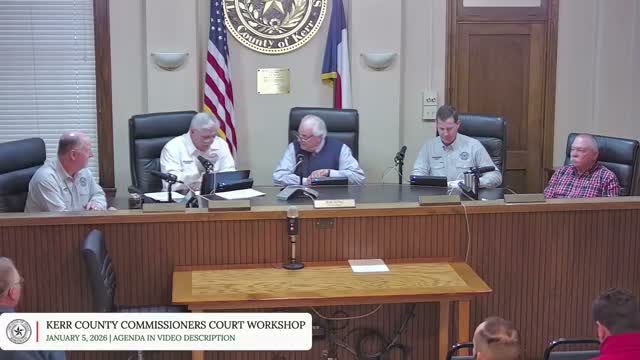
Summary
Kerr County commissioners heard a workshop presentation on risks from battery energy storage systems (BESS), cited multi‑day fires and cybersecurity gaps, and discussed options including permit fees, outside technical review, and hiring a county fire marshal to oversee plan review and inspections.
KERR COUNTY, Texas — County officials held a workshop on Jan. 5 to review safety, regulatory and operational concerns tied to large battery energy storage systems and to consider local steps including permit and fee schedules, contracting outside technical reviewers and the potential hire of a county fire marshal.
The presentation, led by a workshop speaker identified in the transcript as Speaker 2, described containerized lithium-ion battery facilities typically sited beside electric substations and warned of ‘‘thermal runaway’’ fires that can burn for days and produce toxic smoke and contaminated runoff. ‘‘The risk far outweigh any benefit associated with BESS power stabilization,’’ Speaker 2 said, citing cases such as the January 2025 fire at the Moss Landing facility in California that burned for days and led to evacuations and lawsuits.
The presenter and county officials also flagged local projects shown on ERCOT maps. Speaker 3 noted ‘‘13 substations in Kerr County that we’re looking at’’ and described proposed facilities near Comfort (Kendall substation), Mountain Home and Harper — including a 145‑megawatt project in Harper that has prompted litigation in neighboring Gillespie County. The presenter said one Mountain Home proposal reached an advanced documentation stage before being withdrawn; another project remains under active review.
Beyond fire risk, the workshop covered cybersecurity and supply‑chain concerns. The presenter argued critical components and control systems are largely manufactured abroad and cited a Department of Energy finding that many grid‑scale BESS contain components made in China. He also cited the Lone Star Infrastructure Protection Act and recent governor executive orders on vendor attestations, saying more enforcement is needed to ensure compliance.
County staff walked the court through existing legal tools and limitations. Speaker 2 explained counties have authority under Texas Government Code Chapter 352 to act as the authority having jurisdiction for plan review and inspections in unincorporated areas if they designate that role, but noted that developers often proceed through ERCOT interconnection processes and that state entities (ERCOT, LCRA, PUCT) have told the subregional commission they have limited ability to control siting decisions. ‘‘They point fingers towards each other,’’ Speaker 3 said of state and regional entities.
Officials discussed operational mechanics. Under state law, a county has a 30‑day statutory review clock for certain plan reviews; absent timely action, an application can be deemed approved unless the county issues a rejection and the developer resubmits. Van Zandt County Fire Marshal Kevin Palmer (Speaker 6), who joined by phone, described Van Zandt’s approach: a permit and fee schedule sized to project value, a managed document portal so developers ‘‘don’t shotgun blast you’’ with files, and the use of stop‑work orders and temporary restraining orders when necessary. Palmer said his county’s permit for a large BESS project exceeded $50,000 and that outside technical reviewers are routinely used for complex submissions.
To mitigate risk and manage limited staff and expertise, the presenter recommended that Kerr County: adopt or update a resolution naming the authority having jurisdiction, establish a permit and fee schedule to recover review costs, contract with independent technical experts to perform plan reviews and inspections (the presentation named Dr. Robert Steele and Dr. Eric Archibald as potential reviewers), and evaluate hiring a part‑time or full‑time county fire marshal if workload and budget require it. Several commissioners said they supported placing the items on a future agenda for formal action.
The presentation also summarized recent local actions: a Kerr County resolution sent Aug. 26, 2024, to the Texas Commission on Environmental Quality asking denial of environmental permits for BESS in the county; a Jan. 27, 2025, briefing by the State Fire Marshal’s Office; and county authorization on Feb. 10, 2025, to join the Hill Country Energy Subregional Planning Commission with Kendall County. Speaker 2 noted that a proposed statute to require a 1,500‑foot setback did not clear committee in the legislature.
The court did not take a final vote at the workshop. Next steps discussed included drafting a stronger resolution clarifying the county’s role as the authority having jurisdiction, researching the legal mechanics of a permit fee schedule, contracting for outside technical review, and returning the topic to a public agenda for potential formal action.
Speaker list and attributions in this report follow how participants were introduced in the transcript; direct quotes are attributed to the speaker labels used there.