
Kennett Consolidated SD staff outline SEL pilot, plan demos in January
Get AI-powered insights, summaries, and transcripts
Subscribe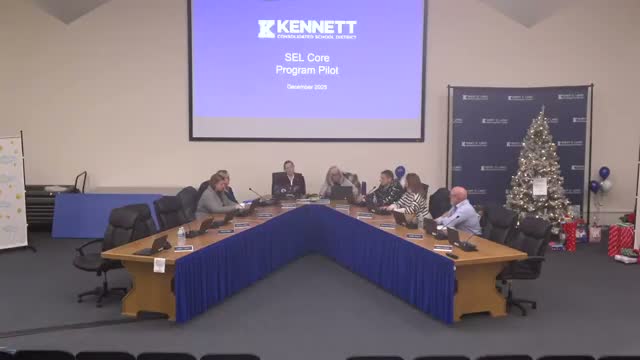
Summary
District staff told the curriculum committee they have shortlisted four SEL programs and will run virtual demos in January, pilot two programs in March, and evaluate in May; the plan responds to DESA screener results showing concentrated needs in grades 7–9.
District staff told the Kennett Consolidated School District Curriculum Committee on Dec. 15 that they will pilot a research‑based tier‑1 social‑emotional learning (SEL) program across K–8 classrooms after a January demo period.
Superintendent Dr. Kimberly Rizzo Saunders introduced Dwayne from the Office of People Services, who said the SEL pilot grew out of the district’s MTSS work and recent results from the Devereaux Student Strengths Assessment (DESA). "Social emotional learning is an integral part of education and human development," Dwayne said as he described the rationale for a cohesive, K–8 core program.
Staff said a core SEL curriculum is missing in current district practice and that DESA results show concentrated needs in grades 7 through 9, making middle‑school transitions a priority. The district’s core team used the Collaborative for Academic, Social, and Emotional Learning (CASEL) program guide to filter options and identified four candidates for review: Character Strong, Wayfinder, Better Together Cubed and Second Step.
The plan calls for virtual demos in January (scheduled in the evenings to maximize staff participation), selection of two pilot programs to test in March, monitoring through April and a formal evaluation in May. Programs will be scored with a hexagon exploration rubric that examines evidence, usability, supports, capacity, fit and need.
Board members asked about pilot costs, teacher input and training. Staff said demo participation is free and pilots will include initial training; final purchasing and ongoing training costs will be determined after the district selects a program. Lynn Golden Margie asked how teacher feedback will be gathered; staff said supervisors and directors will conduct walkthroughs and observations and collect classroom feedback to inform adoption decisions.
Presenters emphasized SEL’s role alongside existing supports. When a board member asked what SEL would not address, staff responded that SEL complements initiatives such as PBIS and restorative practices and that some behavioral or truancy issues may require additional targeted interventions. The presentation closed with staff saying they will continue internal discussions and return with recommendations after January demos.