
Pine-Richland board debates embedding 'DECIDE' decision model and annual attestation into governance policy
Get AI-powered insights, summaries, and transcripts
Subscribe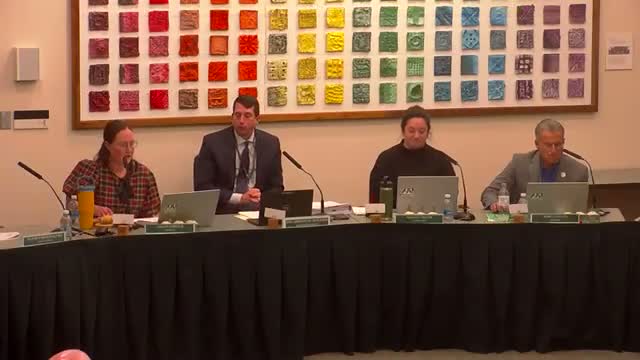
Summary
Board members split over making the DECIDE decision-making model a formal part of Policy 11 and requiring an annual attestation; some want public roll-call signatures for transparency, while others say it could constrain advocacy and decline to sign.
The Pine-Richland School District board spent an extended portion of its Dec. 11 meeting debating whether to embed the DECIDE decision-making model into Policy 11 and require board members to sign an annual attestation committing to those governance principles.
Board President Ashley (S3) and Superintendent Dr. Miller presented the measure as a tool to strengthen cohesion and make decision-making steps visible, not as a prescriptive mandate. The draft attestation would ask directors to affirm they will “provide his or her best effort to honor the principles of governance and leadership in the operating framework outlined through the DECIDE model” and notes that willingness to sign is a condition for additional responsibilities such as subject-area lead assignments (S3).
Supporters said the attestation would increase transparency and accountability. One newly elected director said public signatures and a recorded roll-call vote would let the community know who expressly supports the statement (S13). Another director described the reflection step at the end of each meeting as an opportunity to demonstrate role-model behavior (S14).
Opponents expressed concern that formally embedding the DECIDE model and requiring an attestation could limit a director’s ability to advocate for constituents. One member said explicitly they would not sign the attestation because they did not want a requirement that could “handcuff” their advocacy and argued that the board is not legally required to sign the attestation (S12). Several directors asked whether the process would be mandatory for every decision or reserved for substantive matters; speakers clarified the model is intended as a flexible framework, not a requirement for routine matters such as school trips.
Dr. Miller and other administrators said the DECIDE model has been used intermittently since about 2018 and is meant as a reflective checklist to ensure engagement, public input, and scrutiny of implications. Multiple board members requested clearer public reporting on signatures and an opportunity to debate the policy across the scheduled first, second and third reads.
The board did not adopt the policy at this meeting; leadership invited written suggestions and indicated the item will return at future readings with refinements and potential language clarifying when the model applies and how attestation is recorded.