
State IT agency weighs using $621,000 depreciation reserve for cloud services and ISF needs
Get AI-powered insights, summaries, and transcripts
Subscribe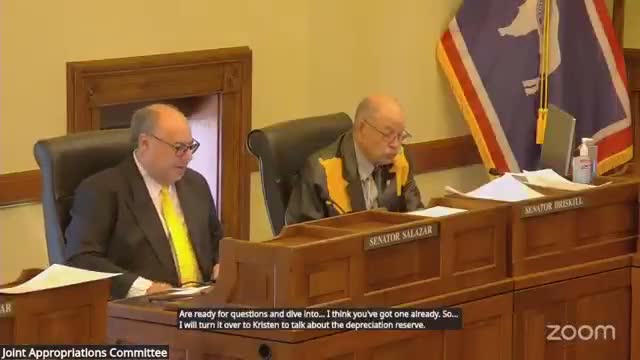
Summary
The Department of Enterprise Technology Services told the appropriations committee it has $621,000 in a depreciation reserve from fully depreciated assets and laid out options to transfer those funds into the internal service fund for ISF exceptions — including applying toward a $1.4 million cloud-service request — or to pay a recurring monthly service charge; lawmakers pressed staff about possible federal-funding entanglements and whether to wait for an audit.
The Department of Enterprise Technology Services (ETS) on Tuesday told the Legislature’s appropriations committee it has "621,000 and some change" in a depreciation reserve created from depreciation of two now-fully depreciated IT assets and proposed several options for using the balance.
Kristen Burkhart, ETS chief financial officer, said the reserve must remain within ETS’s internal service fund (ISF) and described three paths: apply the balance to a recurring monthly service charge ETS currently pays, transfer the money into the ISF to cover an ISF exception request such as a roughly $1,400,000 cloud-service proposal, or use the funds for other ISF-budgeted expenses. "We can also, with your approval, move that money over to the ISF fund and utilize it towards either one of our exception requests," Burkhart said.
The committee probed whether any federal funds were tied to the original purchases. Representative Sherwood asked whether the assets had been bought with federal dollars and whether reallocating the reserve could create federal entanglements. Burkhart initially said the assets were not purchased with federal funds and that the reserve grew from agency billings to other state agencies. She later acknowledged agencies that paid ETS might have used federal funds and said ETS would review agency payment sources before a transfer.
"None of those assets were purchased with federal funds," Burkhart said; when asked to double-check, ETS staff agreed to audit payment histories and interest allocations to ensure a transfer would not inadvertently conflict with federal reimbursement rules.
Director Jeff Clines outlined the broader IT budget context, explaining that ETS is shifting from capitalized infrastructure purchases to cloud-based services. Clines described ETS’s recommended device-replacement strategy and the Total Request for Proposals (TRP) budget requests that accompany it. "Our recommendations are we try to focus on proactive replacement of the computers and stuff like that rather than waiting until they die," Clines said, detailing a typical four-year replacement cycle and the trade-offs between reactive repairs and proactive refreshes.
Committee members also asked about the TRP hardware/software request totals listed in ETS’s budget book: about $5,000,000 for proactive hardware replacement and roughly $3,000,000 for software, producing an approximately $8.2–8.3 million TRP request. Clines told the committee much of the software increase reflects a shift to subscription licensing models (Microsoft, Google, Adobe) that convert previously one-time licensing costs into recurring charges.
ETS said it partners with the Department of Administration and Information surplus program to dispose of retired hardware and will follow up with numbers on revenue from hardware sales. Staff also said they could move forward with a reallocation if the committee directed it, but would first work with the state budget department and the auditor’s office on the mechanics and on verifying there are no federal constraints.
The committee asked for follow-up information on interest earnings associated with the reserve, the historical funding sources used by agencies that paid ETS for the original assets, and a precise accounting of potential proceeds from hardware disposition. ETS agreed to provide those details.
The committee recessed ETS’s callback after the exchange and scheduled further callbacks and public comment sessions for the remainder of the week.