
Richland County ambulance finances strained by collections and billing reconciliation problems
Get AI-powered insights, summaries, and transcripts
Subscribe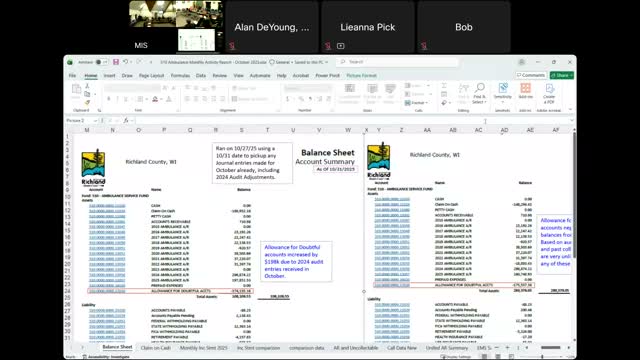
Summary
Finance director told the Joint Ambulance Committee that ambulance gross accounts receivable totaled about $503,000 as of Oct. 31 and, after a $200,000 allowance for doubtful accounts, net collectible AR was roughly $300,000; auditors’ adjustments and large monthly write‑offs have driven recent deficits.
The Joint Ambulance Committee heard a detailed finance briefing on the county’s ambulance service that showed collections shortfalls and accounting adjustments are squeezing its fund balance.
The county finance presenter (identified in the transcript as the finance director) told the committee the ambulance accounts receivable totaled about $503,000 at Oct. 31 and that "after" an allowance for doubtful accounts of roughly $200,000 "we will only receive about $300,000." She said auditors had increased the allowance in 2024 and that auditors’ entries had been applied to simplify older receivables dating back to 2015.
Using year‑to‑date figures, the presenter said the service had taken in about $957,000 in revenue through Oct. 31 and incurred about $1,001,000 in expenses, reducing a beginning fund balance of $108,000 to about $64,000 if closed on that date.
The finance director pointed to a substantial insurance write‑offs line that she described as large this year (discussed as roughly $325,000 year to date in the presentation) and attributed much of the funding gap to how third‑party billing companies and payer adjustments are recorded. "This has been pulled. This has all been verified. These are all audited records that I am presenting to you," she told the committee.
Committee members and staff said reconciling reports from the county’s unified/third‑party billing vendor has been difficult: the presenter reported month‑over‑month report changes, an outstanding December 2024 reconciliation that was not delivered on time, and variances that traced back to a prior vendor. She said the county had gathered quotes from other billing companies and would consider changing vendors once outstanding AR clean‑up is complete.
When asked how much of the net AR might ultimately be written off, the presenter said auditors historically write off about 40% of AR and suggested a conservative estimate that 50% of the $303,000 net could be uncollectible — leaving roughly $150,000 collectible under that scenario.
The presentation concluded with staff offering to add budget‑comparison lines and continue monthly reporting so members could monitor trends as the county and municipalities consider longer‑term funding options.
What happens next: the county plans further reconciliation with the billing vendor, continued monthly financial reporting to the committee, and consideration of alternative billing companies once outstanding accounts are cleaned up.