
Dunn County reviews pretrial screening, diversion program data and strategies to reduce missed court appearances
Get AI-powered insights, summaries, and transcripts
Subscribe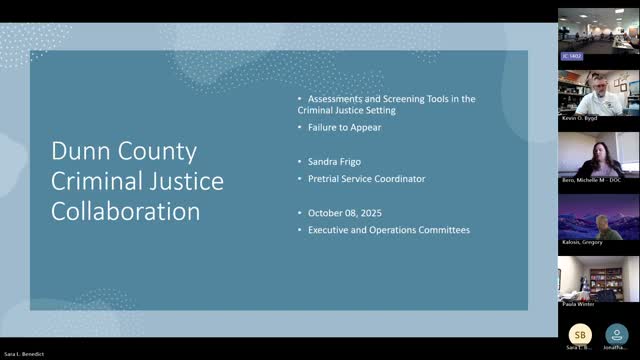
Summary
County staff described use of the Public Safety Assessment, drug and GAIN screeners, reported a 31% failure-to-appear rate among jailed individuals, and gave updated Treatment Opportunity Program (TOP) caseload and outcome figures while noting TOP relies largely on a state TAD grant.
Sandy Frigo, pretrial service coordinator for Dunn County, told the Criminal Justice Coordinating Council that the county uses three screening tools — the Public Safety Assessment (PSA), a face-to-face drug screener and the GAIN short screener — to inform pretrial recommendations provided to judges, defense counsel and the district attorney's office.
"It's completely voluntary. If they choose not to do it, it's not held against them," Frigo said, describing confidentiality protections and how results are compiled into a pretrial recommendation report. She said Dunn County adopted the PSA in June 2023 because it can be completed without a face-to-face meeting and is transparent about how scores are derived.
Frigo reported she completed 235 drug screeners in 2024 and said alcohol and methamphetamine made up more than half of problematic substances reported; the same pattern continued through the first nine months of 2025, with opioids the third most commonly reported substance. She also summarized GAIN short-screener findings showing many respondents scored high on internalizing and externalizing disorder domains.
Frigo said she tracks failure-to-appear (FTA) among people on the county jail list and those who call or walk in; "Our average failure to appear rate ... it's 31 percent," she said, and added that the figure has been steady over the past six years. County staff clarified the 31 percent figure describes the jailed-individual population Frigo monitors, while the Clerk of Court's broader 2024 filing metric showed a 13 percent FTA rate.
"The information that's shared with the judge is not in any way meant to replace their judicial discretion," Frigo said, adding that the county also uses voluntary text-message reminders through the Clerk of Court to help reduce missed appearances.
Janae Brantner, Treatment Opportunity Program (TOP) coordinator, presented TOP's design and outcomes. She described TOP as a post-charge diversion program typically structured for nine months that combines case management, clinical treatment assessment and drug and alcohol testing. Brantner said services are individualized — low-risk participants may have monthly contacts whereas high-risk participants meet weekly.
As of Sept. 30, 2025, Brantner reported 47 active participants and year-to-date figures of 56 referrals, 23 new entrants, 14 graduates, four terminations and four general discharges (medical or transfer to treatment court). She said 17 people were eligible and waiting to start, several others were mid-process, and the program seeks to serve 90 people annually.
Brantner cited performance benchmarks she tracks for the state: Dunn County reached 89 percent (vs a 75 percent benchmark) for completing a Compass assessment within 30 days of referral and met the 90 percent case-plan goal with 100 percent compliance. For 2025 so far she reported a 78 percent success rate (graduation versus termination) and a program-to-date success rate of 61 percent. Brantner said recidivism among program graduates was about 14 percent at one year, roughly 19 percent at two years and 25 percent at three years (figures current to Oct. 6).
On funding, county staff clarified the Department of Corrections does not reimburse Dunn County for providing TOP services; Brantner and Sarah said the program is largely funded by the state TAD (Treatment Alternatives and Diversion) grant designed to reduce jail and prison populations. Michelle Barrow added that ATR referrals from probation typically continue to report to their supervising agent while also receiving additional urine analyses and supports through TOP.
Brantner said Dunn County has been involved in statewide diversion work, coauthoring a November 2024 outcome-and-performance report and co-facilitating statewide diversion coordinator meetings. She cited a state report that estimated a return on investment of $8.18 to $9.12 for every dollar spent on TAD-funded diversion programs.
The council briefly discussed the Sequential Intercept Model (SIM) as a framework for mapping how people with behavioral-health needs move through the justice system; participants noted prior SIM mapping during COVID did not yield a final report due to grant limits and debated whether a full remap was needed now or whether the existing map should simply be posted for public view. A targeted remap for specific processes such as warrants was proposed as an alternative.
The meeting ended after brief housekeeping: staff noted additional items were in the written packet and announced the next full CJCC quarterly meeting on Nov. 20 and an executive/operations committee meeting on Dec. 10.