
La Porte council approves rezoning of former Bridal Golf Course despite neighbors' concerns about fire risk and wetlands
Get AI-powered insights, summaries, and transcripts
Subscribe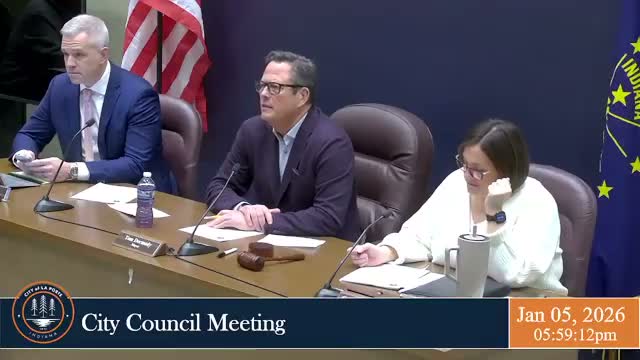
Summary
After hours of public comment raising fire-safety, setback and wetland concerns, the La Porte Common Council approved an ordinance rezoning two parcels (including the former Bridal Golf Course) to allow higher-density single-family development; developers and city staff said further site plans and state environmental reviews remain required.
The City of La Porte Common Council on Jan. 5 approved an ordinance amending the zoning map to rezone two parcels, including the former Bridal Golf Course site, clearing the way for higher-density single-family development by the parcel purchaser and its homebuilder partner.
Neighbors and environmental advocates urged the council to delay or deny the change. David Ambers, an attorney representing nearby property owner James Schaffner, told the council the proposed change from R1B to R1D "is spitting in the face of the master plan," and argued narrow lots and reduced setbacks would harm neighborhood character and pose fire risks. Jacob Hill submitted a written statement that "regional botanists and ecologists" from the Indiana Department of Natural Resources had identified "multiple rare plant species and the potential for rare aquatic life" in a portion of the site known as Autumn Bog and said the DNR review was ongoing.
Other residents warned of congestion and emergency-access issues. Carrie Metcalfe said the plan as shown had only a single entrance/exit and "the parking spots are too tight," raising the possibility that emergency vehicles could be blocked during a response. Ethan Coontz told the council he had contacted the Indiana Department of Environmental Management and that IDEM had confirmed there is currently "no wetland classification for Autumn Bog," no professional wetland delineation and no permit applications on file; he requested the council table rezoning until a formal delineation, a U.S. Army Corps of Engineers jurisdictional determination, and an IDEM waters-of-the-state determination were completed and made available for public review.
City and developer representatives responded that rezoning (a map amendment) is a separate procedural step from development-standard variances and site-plan approvals. Attorney Otis told the council this body was considering only the map change and that variances are handled by the Board of Zoning Appeals. Bert Cook, executive director of the La Porte Economic Advancement Partnership, said the developer had revised site plans in response to neighbor feedback and that a cul-de-sac would be added on the eastern border; he added that the builder had been "very responsive to the neighborhood" while noting some concessions (for example, single-story homes) are design decisions the builder may or may not accept.
Council members debated density, infrastructure and the trade-offs between preserving larger lots and providing new housing stock. After discussion the council conducted a voice vote; the chair called for the vote, members answered "Aye," and the motion passed. The ordinance was adopted by voice vote; no roll-call tally was recorded in the meeting transcript.
The rezoning approves a map amendment only. Next steps include developer submittal of a final site plan, any required BZA variances (which the BZA reviews and decides), and state-level environmental reviews and permitting (wetland delineation, USACE jurisdictional determination, IDEM review) before site work could begin. Neighbors and at least one public-commenter urged that those environmental determinations be completed and made public before final approvals are granted.
The council did not record a roll-call vote on the ordinance in the transcript; the meeting record shows the motion carried on a voice vote.