
Supreme Judicial Court Hears Appeal Over Juvenile’s Conviction for Reposting Violent Meme
Get AI-powered insights, summaries, and transcripts
Subscribe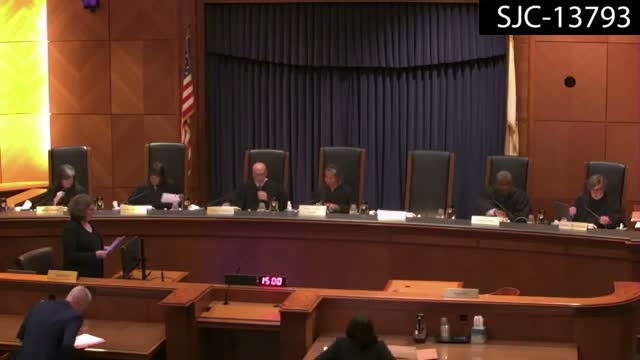
Summary
At oral argument, the court considered whether reposting a TikTok meme by a high‑school student sufficed to prove subjective intent to threaten, or whether the evidence required a new trial due to an omitted jury instruction; prosecutors pointed to the meme’s content, deletion, and the juvenile’s comment about a 'dark sense of humor.'
BOSTON — The Supreme Judicial Court on Tuesday heard argument in an impounded appeal by a juvenile convicted after reposting a violent meme on TikTok, with defense counsel saying the evidence was insufficient to prove the student intended a threat and prosecutors saying the post and surrounding facts supported the conviction.
"This case is about a child who merely pressed a button," Dennis Toomey, counsel for the juvenile, told the court, arguing the record contained "no eyewitness" and no evidence that the juvenile "adopted" the meme’s language as his own willful communication. Toomey said the absence of a jury instruction on the element of subjective intent prejudiced the defendant and warranted relief.
Hallie White, an assistant district attorney for Middlesex representing the Commonwealth, responded that "the content of the meme is certainly important" and that the post — shared from a public profile by a high‑school student and reposted without any disclaimer — could be considered together with other trial evidence, including the student’s statement to police that he had a "dark sense of humor," to sustain the conviction.
Justices pressed both sides on core legal questions: whether appellate review may draw reasonable inferences from the message itself; whether deletion of the repost or a self‑description of a dark sense of humor tends to show conscious awareness; and how to balance sufficiency review under the standard of viewing the evidence "in the light most favorable to the Commonwealth." One justice raised concerns about potential First Amendment chilling effects if reposting were treated as per se criminal.
Defense counsel emphasized the juvenile context. "Children are much more likely to act impulsively and not consciously consider the consequences of their actions," Toomey said, arguing that without personalization of the post (for example, a caption naming the school or sending the image directly to a staff member), reposting a third‑party meme is consistent with accidental or non‑culpable conduct.
The Commonwealth maintained that reposting is an act of dissemination that can carry communicative force distinct from merely "liking" a post. White told the court that while "repost does not equal endorsement" is a common social‑media convention, a repost from a personal account can still be viewed as a communication from that account and is therefore relevant to the mens rea inquiry.
Counsel and the justices also debated precedent. The parties and bench referenced Counterman and Cruz during argument while questioning whether a Counterman‑style mens rea was preserved at trial and whether any instructional error survives when compared to harmless‑error standards. The record includes a witness who testified she was frightened by the image after going to the juvenile’s public profile; the timing of the posting and the precise moment of deletion were not established in the trial testimony and remain uncertain in the record.
No decision was announced at argument. Both sides asked the court to rely on written briefs; the justices’ questioning indicated scrutiny of how the subjective intent element should be applied where a juvenile reposts third‑party content on social media. The court will take the matter under advisement and issue a ruling in due course.