
High court hears arguments on whether 123-day delay to search cellphone was unreasonable
Get AI-powered insights, summaries, and transcripts
Subscribe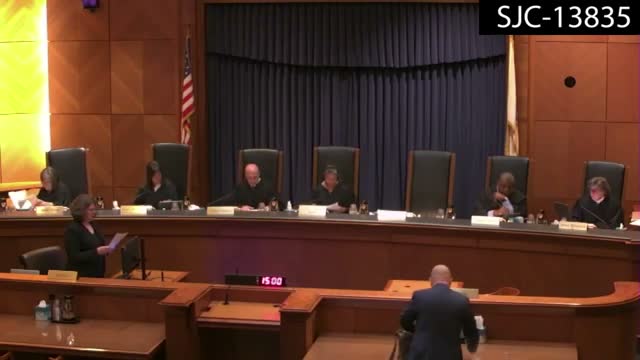
Summary
At oral argument in Umwell v. Michael A., the Commonwealth urged reversal of a suppression order, saying the cellphone seizure incident to arrest was lawful and the 123-day delay before obtaining a warrant was reasonable under the circumstances; the defense urged affirmance, saying the delay and the lack of urgency rendered the search unreasonable under White.
The Supreme Judicial Court heard competing arguments over whether a 123-day delay between a lawful seizure of a cellphone incident to arrest and the eventual magistrate-issued warrant rendered a subsequent search constitutionally unreasonable.
Kalyn Campbell, arguing for the Commonwealth, asked the court to "reverse the allowance of the defendant's motion to suppress," conceding that the phone "was properly seized as evidence, incident to arrest" but contesting the motion judge's separate holding that the police took an unreasonable time to obtain a warrant under the court's White precedent. Campbell told the court she accepted that a Fourth Amendment reasonableness inquiry applies after seizure, but she disputed that White imposes a categorical obligation to obtain a warrant within a rigid, short period.
The presentation focused on how to weigh competing interests. Campbell emphasized an analytical distinction between a possessory right (dominion over a physical object) and a privacy interest in data stored on a device, arguing that the seized handset can itself have independent evidentiary value—"if it's properly seized and secured," the Commonwealth said, it may be retained as evidence pending trial. She also urged the court to avoid a bright-line rule on the number of days that would be per se unreasonable, noting investigative complexity and citing precedents in which extended delays were found reasonable in particular circumstances.
Defense counsel George Olsen asked the court to affirm the motion judge's decision, arguing the 123-day interval was unreasonable on the record. "I would ask that the court affirm the ruling that the... hundred and 23 days, was unreasonable," Olsen told the justices. He emphasized that the trial record contains testimony that obtaining a warrant was placed on the "back burner," and he urged that defendants should not bear the burden of filing a motion for return of property to preserve possessory rights in circumstances where police deprioritize warrant applications.
The bench pressed both sides on several points. Justices asked whether modern digital realities mean the core interest is access to the phone's contents rather than the physical device, whether the phone had been made effectively "static" (e.g., placed in a Faraday bag), and whether victims had identified the seized handset as the instrument used in the alleged offenses. Counsel for the Commonwealth pointed to the possibility that a distinctive phone could corroborate a victim's testimony, while the defense countered the record contains no evidence that the specific phone had been identified by victims.
Doctrinally, the arguments turned on White and related authorities. The Commonwealth relied on a balancing approach drawn from precedent including United States v. Place and Commonwealth cases, while the defense relied on White's remedial logic and the motion judge's finding that, given the length of the delay and the testimony about the lack of urgency, exclusion was appropriate. Counsel referenced additional cases appearing in the record (including Commonwealth v. Sacco, and a case counsel cited as Jarman) to frame the permissible range of delay in context.
No decision was announced during argument. Counsel completed oral presentations and rested; the court did not rule from the bench during the session.