
Kennett Consolidated SD policy committee forwards package of governance and financial policy updates to full board
Get AI-powered insights, summaries, and transcripts
Subscribe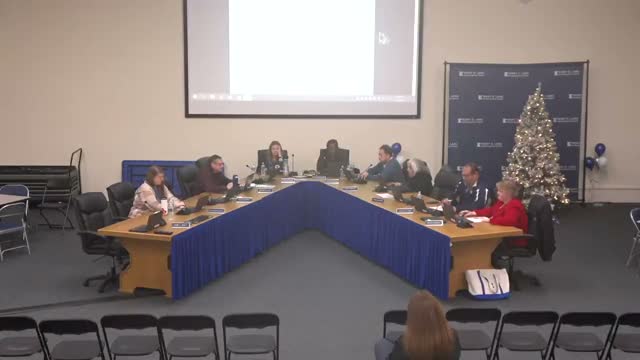
Summary
On Nov. 24 the Policy Committee recommended that the full Kennett Consolidated School District board approve a package of updated policies covering electronic attendance, procurement thresholds, payroll and student activity funds; several amendments were adopted before forwarding.
The Policy Committee of the Kennett Consolidated School District voted on Nov. 24 to recommend a set of revised governance and financial policies to the full board for approval.
Unidentified Staff (presenter) summarized the package as updates that replace the term 'board member' with 'school director' where relevant, update purchasing thresholds (reflecting state-set limits and CPI adjustments), modernize payment language to include electronic transfers, and streamline petty cash and cooperative-purchasing language. "This policy is just updating our attendance, at meetings via electronic communication," the staff presenter said when introducing Policy 6.1.
The committee considered and approved a substantive amendment to the minutes from the prior meeting clarifying that Policy 6 had been split and that the committee made no recommendation to the full board on that item. For Policy 6.12 (purchases not budgeted) the committee adopted an amendment to replace the phrase "when funds are not available" with "when funds are not budgeted for a proposed appropriation," clarifying the trigger for the budget-transfer process.
Discussion on Policy 6.1 (attendance via electronic communication) focused on wording and statutory alignment. One committee member said the draft's phrase "electronic communications" read oddly compared with how the district actually expects virtual participation (audio and visual access). Staff responded that the language reflects the Pennsylvania statute and PSBA guidance. A committee member questioned use of the adjective "extraordinary" versus "special," noting ordinary work-related absences may not feel "extraordinary"; staff pointed to statute language as the basis for keeping the phrasing.
On procurement, staff said redline changes to Policy 6.10 update bid thresholds and delegation of responsibility to reflect current district titles and the state-prescribed thresholds. The committee clarified that quotations under certain dollar thresholds may be collected by phone or electronically but must be documented; staff said the policy requires written documentation when above the threshold and that electronic records may satisfy the requirement.
Other policies recommended to the full board included payroll authorization (Policy 6.14), payroll deductions (Policy 6.15, amended to add employee notification language around garnishments), payment of bills (Policy 6.16), petty cash (Policy 6.17), and student activity funds (Policy 6.18). For student activity funds staff described administrative controls: funds collected by advisors are turned in to building administrative assistants (custodians), check requests carry multiple signatures (club members, advisor, principal, CFO) and issued checks carry two board-member signatures.
All policy motions were forwarded by the committee with committee recommendation for approval; the recorded committee votes were unanimous among the two members present when votes were taken. Each policy packet includes administrative regulations with operational detail, which staff said would be used to implement practices such as documentation of sole-source justifications and petty-cash custodianship.
The committee moved the recommended policies to the full board for consideration. The Policy Committee will next meet on the full-board agenda as those items are scheduled for board action.