
High court hears arguments over whether 110‑day delay to search seized cellphone requires suppression
Get AI-powered insights, summaries, and transcripts
Subscribe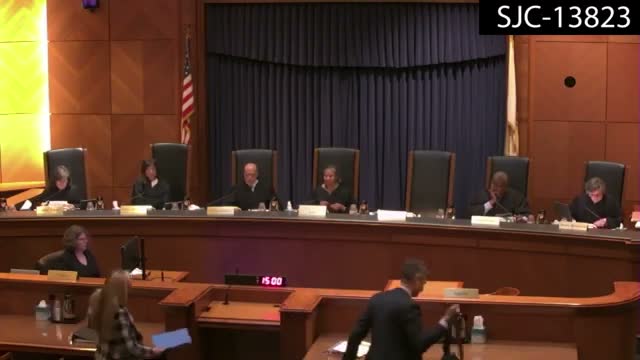
Summary
The Supreme Judicial Court heard oral argument in Commonwealth v. Solis over whether a roughly 110‑day delay between seizing a cellphone incident to arrest and obtaining a search warrant required suppressing its contents; the Commonwealth said the phone’s role as an alleged instrumentality lowers possessory interests, while the defense said delay and lack of diligence justify exclusion.
BOSTON — The Supreme Judicial Court heard competing legal arguments over whether a long delay in seeking a search warrant after a cellphone was seized incident to arrest requires courts to suppress evidence.
Brooke Hartley, attorney for the Commonwealth, told the court the case turns on the familiar distinction between possessory and privacy interests: "I think it's easy to conflate privacy interests and possessory interests, and a seizure affects only possessory interests, whereas a search affects privacy interests." Hartley argued that when police seize an item they reasonably believe is an instrumentality of a crime — here, a phone a child victim later said was used to take images during an assault — the possessory interest of the defendant is diminished and that fact should inform the balancing test courts apply.
Matt Spurlock, counsel for defendant Jose Solis, urged the court to preserve the rule that unreasonable delay in seeking a warrant can bar admission of evidence obtained after an initial warrantless seizure. "When an officer unreasonably takes a long time to seek a search warrant, he cannot later seek to have that evidence admitted," Spurlock said, arguing the rule prevents officers from relying on unilateral discretion to hold devices for long periods before judicial review.
The argument turned on precedent. Counsel debated how to apply decisions such as White, Arthur and Burghardt and whether the possibility that a phone served as an "instrumentality" of the offense should reduce the need for prompt warrant application. Hartley said cases involving probable cause about a phone's contents invite prompt judicial review; she distinguished those from seizures that will be held as evidence throughout trial. Spurlock countered that permitting an "independent evidentiary value" exception without a durational or diligence constraint would swallow existing Fourth Amendment protections for litigants whose phones are taken incident to arrest.
The record includes contested factual points the justices pressed: a victim initially described the phone as a black Samsung but the device recovered was a blue Nokia; a motion judge later concluded the initial seizure was lawful but also found the government did not act diligently in pursuing a warrant. Counsel discussed practical safeguards such as motions to regain possession, continuances and the role of neutral magistrates in checking officers' decisions.
The court did not announce a ruling at the argument's close. The justices questioned whether a bright-line time limit is appropriate, how to measure police diligence and whether the independent‑evidentiary‑value rationale would apply broadly to routine seizures. The case returns to the court for decision on how to reconcile the competing concerns of prompt judicial oversight and law‑enforcement investigatory needs.