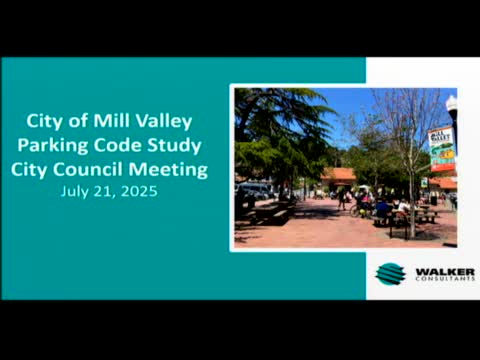
Mill Valley council favors eliminating downtown parking minimums for small projects and backs shared-parking, staff-directed ordinance
Loading...
Summary
After a data-driven review by Walker Consultants, the Mill Valley City Council directed staff to draft a parking ordinance that removes minimum parking requirements for nonresidential projects under 5,000 sq ft in the downtown/Miller Avenue area, increases shared-parking allowances, updates residential ratios, and declines to resurrect a broad in-lieu parking fee.
The Mill Valley City Council voted July 21 to direct staff to prepare a new parking ordinance that would eliminate minimum parking requirements for most change-of-use or small new nonresidential projects under 5,000 square feet in the downtown and inner Miller Avenue corridors, while preserving a 3-per-1,000-square-foot threshold for larger projects and expansions.
Council and staff framed the decision around a Walker Consultants study presented at the meeting that measured on-street and lot occupancy and commercial parking demand. Walker reported that curbside on-street occupancy peaked at about 83% at Friday evening peaks, public lots averaged roughly 77% occupancy and some private lots were underused (about 48%). The consultants calculated a downtown commercial parking ratio near three parked cars per 1,000 square feet, which they said is consistent with prior city data dating to 2010.
Why it matters: Councilmembers repeatedly emphasized that parking minimums have kept some small businesses from locating in Mill Valley and that most downtown storefronts are under the 5,000-square-foot threshold. Eliminating the mandate for those smaller spaces is intended to reduce time and cost for landlords and prospective tenants and promote adaptive reuse of existing buildings without immediately increasing curb demand.
Key elements staff were asked to draft into the ordinance include: - Elimination of nonresidential minimums for projects under 5,000 sq ft; application of a 3/1,000 standard for larger projects or substantial expansions. - Adoption of the city’s housing-overlay residential parking standards (1 space per unit for units under 1,000 sq ft; 1.5 spaces per unit for units over 1,000 sq ft) to align with state density-bonus rules. - Raising the allowable shared-parking reduction for mixed-use projects from the existing 10% cap to as much as 40%, subject to land-use mix and analysis. - Updates to parking geometrics, notably shortening stall length from 20 feet to 18 feet in some circumstances to increase feasibility of on-site parking where possible.
Council rejected creating a new, broad in-lieu parking fee program at this time, citing limited revenue potential to build new parking, fairness concerns for existing businesses, and no firm plan for how collected funds would be spent.
Neighborhood and management concerns: Several residents urged protections for “pinch-point” neighborhoods adjacent to downtown, including shorter time limits (for example a 2-hour cap) and more active enforcement, to prevent employee parking and long-term vehicle storage from displacing residents. Council directed staff to preserve neighborhood protections in subsequent parking-management work and to pursue wayfinding and shared-parking agreements to better distribute vehicles to underutilized lots.
Next steps: Staff will draft an ordinance reflecting council direction for Planning Commission review, with a schedule discussed in the presentation that anticipates a Planning Commission review in September and council consideration around November. Staff also flagged a separate but related parking-management work program (enforcement, employee-permit hours, time limits, wayfinding) that will proceed in parallel but not be finalized tonight.