Get Full Government Meeting Transcripts, Videos, & Alerts Forever!
Get email alerts on the Parking topic
No spam. Unsubscribe anytime.
Mill Valley council introduces overhaul of parking rules aimed at easing downtown development
Summary
City staff presented a rewrite of Title 20 parking rules that reduces commercial parking ratios, exempts small uses and small expansions, and modernizes EV, bike and ADA standards; council voted to introduce the ordinance and waive first reading, with second reading scheduled for Nov. 17.
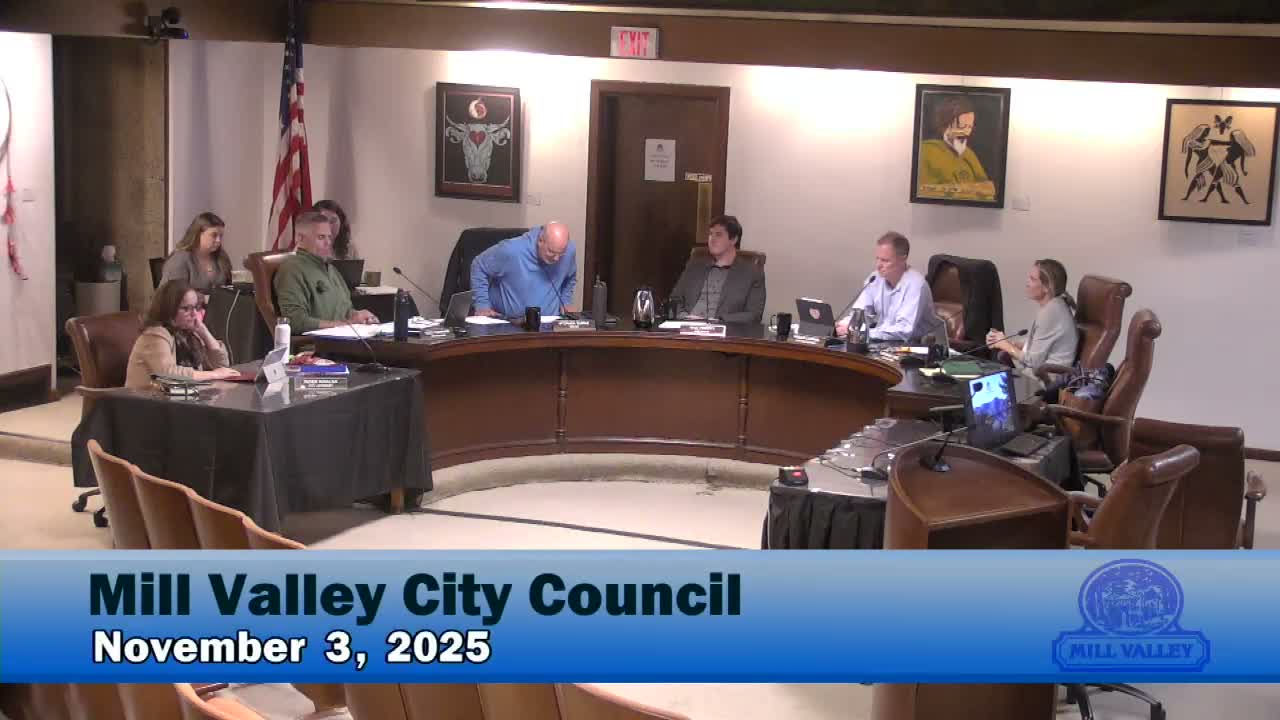
A majority of the Mill Valley City Council on a unanimous voice vote introduced a zoning ordinance to modernize the city’s parking requirements and waived the first reading.
City planning staff, led by Director Patrick Kelly, said the draft ordinance reorganizes parking regulations into a new chapter, aligns parking ratios with measured demand from a May 2025 parking study, and reduces parking burdens for many commercial uses. “The recommendation is introduction and to waive the first reading of a proposed ordinance,” Kelly told the council as he walked members through examples showing how several conversion or expansion scenarios would require far fewer spaces under the new standards.
The ordinance would set a blended standard tied to observed demand—an example given by staff reduced restaurant parking ratios from 10 spaces per 1,000 square feet to 3 per 1,000—and creates exemptions for small uses and small expansions: no parking would be required for new uses under 5,000 square feet, and expansions under 1,000 square feet would be exempt from parking requirements. Staff also recommended updated loading and parking-dimension standards, EV and bike parking provisions, shared-parking reductions (10%–40% depending on conditions) and a cross-reference to state density-bonus law.
Council members asked how the changes would affect existing private arrangements—such as restaurants that lease or subsidize parking on neighboring lots—and staff replied those agreements are private and would remain governed by their contracts, while new uses would benefit from the relaxed standards. Staff noted that shared-parking agreements and other private arrangements could change over time as the city’s rules evolve.
The council moved to introduce the ordinance and waive further reading; the motion was seconded and approved by voice vote. If the council follows the schedule staff proposed, the second reading would be set for Nov. 17 and the ordinance would become effective 30 days after adoption. Staff said it will prepare public-facing materials to explain the changes and update the city’s informational handouts.
What happens next: The council will return for a second reading on the ordinance, and staff will publish guidance for developers and property owners explaining the new ratios, exemptions and implementation details.