
Killeen reviews new tiered special-events rules and removes food trucks from itinerant-vendor permit ahead of state changes
Get AI-powered insights, summaries, and transcripts
Subscribe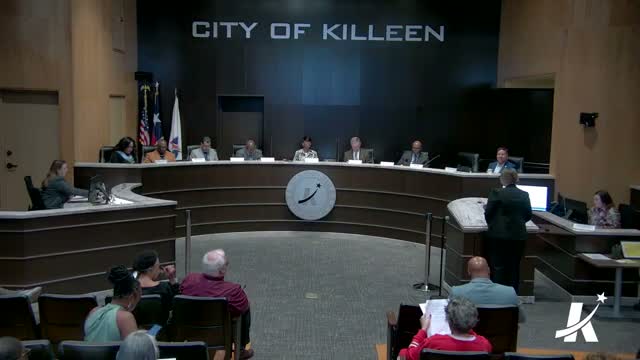
Summary
City attorneys and staff presented a consolidated special-events ordinance with a four-tier permitting structure and proposed removing mobile food vendors from the city itinerant-vendor permit to align with House Bill 2844; council discussed insurance, protests and enforcement but took no final standalone ordinance vote at the work session.
City staff told Killeen council members on Jan. 6 that a consolidated special-events ordinance is intended to make permitting clearer and to reflect current public-safety and resource-management needs.
Assistant City Manager Wilson described a tiered structure that categorizes events by size and operational impact: Tier 1 for minor neighborhood events (shorter review window), Tier 2 for limited-impact gatherings (100–500 attendees), Tier 3 for moderate-impact events (500–1,000 attendees), and Tier 4 for large or multi-day events (more than 1,000 attendees). Staff recommended allowing alcohol service starting at Tier 3 in response to applicant demand, building predictable application timelines, clarifying vendor placement rules, encouraging use of parking lots for small events instead of street closures, and adding appropriate insurance requirements for larger events.
The city attorney also presented proposed changes to Chapter 20 to remove mobile food trucks from the city’s itinerant vendor permit because House Bill 2844 creates a state mobile-food-vendor license effective July 1, 2026. Staff said removing duplication would prevent requiring both a state license and an itinerant-vendor permit for the same activity; they advised the city may still regulate non-conflicting items such as signage.
Council raised a series of operational and civil-liberties questions during the discussion. Members asked how the city would handle competing applications for the same date, how prior compliance history would affect approvals, and whether a required insurance premium could be cost-prohibitive for small organizers. Councilmember Gonzales specifically asked whether protests and assemblies would be covered by the consolidated framework; staff and the city attorney explained that assemblies (including protests) are included and that emergency application language permits 48-hour submissions or 'as soon as reasonably practical' in certain circumstances. The city attorney reminded the council that the ordinance applies to assemblies of 25 or more people, and that there is limited preemption by state law on some matters.
Staff told council that submitted permits will be routed to the city secretary’s office and then to affected departments (public works, police, fire, animal services) for review and that prior event compliance history would be considered when permitting recurring organizers.
No council motion to adopt the ordinance on first reading was recorded in the work session transcript; staff recommended adoption as written but said fee levels would be brought back through the regular fee-review process after benchmarking against comparator cities.
Council requested additional attention to free-speech implications for assemblies and to ensure emergency/short-notice assembly options remain practicable, and asked staff to clarify operational enforcement mechanisms and who is authorized to suspend events for public-safety reasons.
If adopted later, the proposed ordinance would consolidate permitting into a single chapter, allow tailored permit timelines, introduce insurance and liability requirements for larger events, and permit city staff to assess requests based on available resources and prior compliance.