Destin council trims parks master plan, skips Phase 3 and advances implementation work
Summary
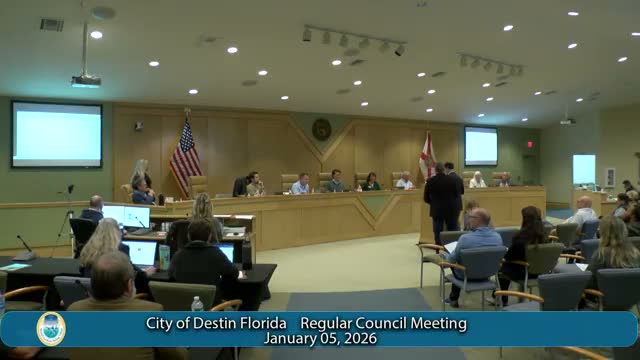
After a two-hour presentation and council questions, the City Council voted to eliminate Phase 3 of the Parks and Recreation System Master Plan and proceed to phases focused on implementation and funding analysis, citing cost concerns and the need for CIP-level numbers amid possible changes to state property‑tax rules.
Consultants told the City Council that the parks and recreation master plan work to date showed broad resident support for maintaining and improving existing parks, expanding beach access and optimizing connectivity. After a two-hour presentation and detailed Q&A, the council voted to drop Phase 3 of the consultant’s proposed next steps and move directly to implementation and funding analysis.
Carlos Perez of Perez Planning and Design summarized the first two phases, reporting more than 450 survey responses and an analysis that identified three priorities: modernize the system, integrate facilities and programs, and optimize resources. Perez told the council the team would produce CIP‑level cost estimates and operational impacts in later phases to help the city prioritize capital and operations spending.
Multiple council members pressed consultants for clarity on methods and outcomes. Councilman Schmidt questioned the market‑potential index results and where some elevated metrics (for example, high spending categories tied to sports equipment) came from; Perez said the index is built from transactional data and is triangulated with survey and public‑meeting results.
The council debated scope and cost. One public commenter noted the city had already spent $86,000 on the study and unsettled work proposed in the next phases would add roughly $44,000; several council members expressed reluctance to spend yet another tranche before seeing firm CIP numbers. Councilwoman Trammell initially moved to authorize phases 3–5 with Perez Planning and Design. In response to budget and redundancy concerns, a substitute motion to eliminate Phase 3 and proceed to phases 4 and 5 — focused on implementation and funding options — was adopted by council vote.
On the record, the mayor announced the substitute motion passed by the council; staff will now work with the consultant and the city manager to scope the implementation phase and provide order‑of‑magnitude cost estimates and operations impacts for council review. Perez said the revised scope will still aim to produce the CIP prioritization and funding scenarios the council requested.
Next steps: staff will return with revised work‑scope language and estimated costs for the implementation/funding analysis phases, plus an updated timeline and deliverables for how resident input will be incorporated during visioning and funding scenario exercises.