
Smyrna planning commission backs amendment allowing 45 townhomes and a 5,023‑sq‑ft drive‑through; neighbors cite traffic and child‑safety concerns
Get AI-powered insights, summaries, and transcripts
Subscribe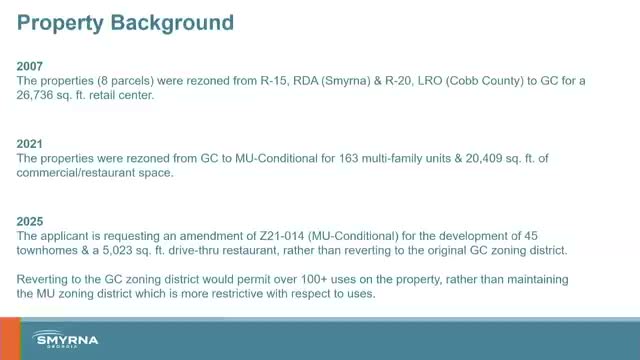
Summary
The Smyrna planning commission voted 3–2 to recommend approval of Z 25‑015, amending a prior 2021 mixed‑use approval to allow 45 townhomes and a 5,023‑sq‑ft drive‑through restaurant (proposed as a Chick‑fil‑A). Neighbors warned of queue spillback at a five‑point intersection, school‑bus and pedestrian safety risks, and urged more traffic analysis; applicants and Chick‑fil‑A representatives said preliminary agency review has occurred and on‑site stacking will limit spillback.
The Smyrna Planning Commission recommended approval, by a 3–2 vote, of Z 25‑015 — an amendment that replaces a previously approved 2021 conditional mixed‑use plan for 163 multifamily units and about 20,409 square feet of commercial space with 45 fee‑simple townhomes (maximum) and a 5,023‑square‑foot drive‑through restaurant. The recommendation goes to the mayor and council for a final vote.
The case drew extended public comment from residents who live along Oakdale Road and in nearby neighborhoods. Mike Kennedy, a property owner directly opposite the site, urged the commission to deny or defer the application, saying the proposed drive‑through adjacent to a complex five‑point intersection risks queueing that could spill into the public right‑of‑way and endanger roughly 40 homes. "Approving this without solid analysis places the burden on the neighborhood first and asks the questions later," Kennedy said.
Neighbors raised several recurring concerns: the absence (in the packet) of a traffic impact or stacking study specific to the five‑point intersection; proximity of existing school‑bus stops and pedestrian links (including the Silver Comet Trail connection) to the proposed double drive‑through; removal of a previously proposed sound wall from the plan; and the use of stacked variances that residents said effect a de‑facto commercial rezoning. "Eighty‑three percent of the parcels are single‑family," resident Kate Shaw told the commission, arguing that the stacked variances convert the site to high‑intensity commercial without a formal rezoning process.
Applicant Park Lamberts of Arris said the amended plan responds to market and subsurface constraints — notably rock that makes multifamily foundations costly — and reduces overall residential and commercial square footage from the 2021 approval. He said the team has discussed the project with GDOT and other agencies and intends to provide landscape buffers and other screening measures. "We have discussed it with [the home builder] and they plan to do some sort of either natural vegetative buffer or fencing that would separate the two," Lamberts said.
David Kirk, land‑use counsel for Chick‑fil‑A, urged commissioners to rely on the staff recommendation and preliminary agency reviews, and said the proposed double (or multi‑lane) drive‑through increases on‑site stacking capacity compared with a single‑lane design and is intended to reduce spillback. Kendra Lewis, a site representative, said a preliminary study informed deceleration lanes and the design and that South Cobb Drive (under GDOT jurisdiction) is expected to serve as the primary entrance, with Oakdale access subject to city and county review.
Staff presented the site's rezoning history, summarized recommended conditions and variances, and listed technical requirements that remain: underground utilities, tree and landscape standards, fire/access/water/sewer/stormwater improvements, right‑of‑way dedications where needed, GDOT and Cobb County approvals for affected roads, required deceleration and right‑turn lanes, and a hard cap that residential units not exceed 45 townhomes. Staff recommended maintaining the conditional mixed‑use (MU) zoning with the amended site plan rather than reverting to the prior GC zoning.
After public comment and applicant rebuttal, a commissioner moved to approve Z 25‑015 "as presented." The motion passed 3–2; the commission recorded the recommendation and directed that the matter proceed to mayor and council for final action. The record includes inconsistent remarks about the final‑vote date (staff stated the mayor and council meeting is February 16; the chair later referenced May 16), and staff said agency approvals (GDOT, Cobb County) are required before issuance of permits.
What happens next: the planning commission's approval is a recommendation to the mayor and council. The council will schedule the final vote; related road and access work will require separate review and approvals by GDOT and Cobb County for portions of the project within their jurisdictions. The commission's approval included multiple conditions and variances that will be incorporated into the project's site‑plan approval and subsequent civil engineering submittals.
Details and figures cited in the hearing: the previously approved plan (2021) allowed 163 multifamily units and ~20,409 sq ft of commercial/restaurant space; the amended proposal reduces residential to a maximum of 45 townhomes (10 units per acre in staff wording) and provides a 5,023‑sq‑ft drive‑through with approximately 67 parking spaces. Public commenters referenced an ITE land‑use estimated trip generation of about 2,300 vehicle trips per day for a fast‑food site of this size; the applicant and Chick‑fil‑A representatives said a preliminary traffic analysis and agency conversations informed the design but neighbors asked the commission to require formal traffic and school‑bus safety studies.
The commission's record lists multiple specific variances and conditions (setback reductions, drive‑through location allowances, menu‑board canopy accessory structure, dumpster screening, landscape buffers, sidewalk/ROW dedications, and a requirement that the development not be gated). The commission and staff repeatedly noted that any work in state right‑of‑way will require GDOT approval and that county jurisdiction applies where relevant.
The meeting record reflects strong neighborhood opposition focused on traffic, pedestrian and school‑bus safety, and process (stacked variances versus a commercial rezoning); applicant and operator representatives emphasized reduced overall density versus the 2021 approval, mitigation through on‑site stacking and screening, and jurisdictional review by GDOT and Cobb County as safeguards. The planning commission's recommendation carries the case to the mayor and council for a final decision.